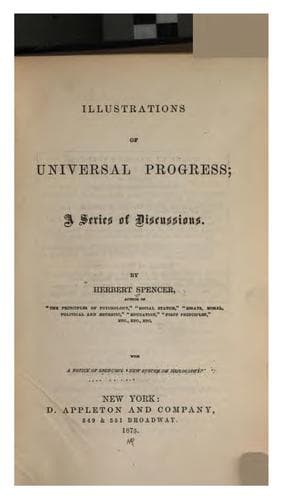
Illustrations of Universal Progress: A Series of DiscussionsSpencer, Herbert
Philosophy
Illustrations of Universal Progress: A Series of Discussions
Spencer, Herbert
Philosophy; Political science; Science
Similarly with domestic animals. Though in some cases--as that of
dogs--community of origin will perhaps be disputed, yet in other cases--as
that of the sheep or the cattle of our own country--it will not be
questioned that local differences of climate, food, and treatment, have
transformed one original breed into numerous breeds now become so far
distinct as to produce unstable hybrids. Moreover, through the
complications of effects flowing from single causes, we here find, what we
before inferred, not only an increase of general heterogeneity, but also of
special heterogeneity. While of the divergent divisions and subdivisions of
the human race, many have undergone changes not constituting an advance;
while in some the type may have degraded; in others it has become decidedly
more heterogeneous. The civilized European departs more widely from the
vertebrate archetype than does the savage. Thus, both the law and the cause
of progress, which, from lack of evidence, can be but hypothetically
substantiated in respect of the earlier forms of life on our globe, can be
actually substantiated in respect of the latest forms.
If the advance of Man towards greater heterogeneity is traceable to the
production of many effects by one cause still more clearly may the advance
of Society towards greater heterogeneity be so explained. Consider the
growth of an industrial organization. When, as must occasionally happen,
some individual of a tribe displays unusual aptitude for making an article
of general use--a weapon, for instance--which was before made by each man
for himself, there arises a tendency towards the differentiation of that
individual into a maker of such weapon. His companions--warriors and
hunters all of them,--severally feel the importance of having the best
weapons that can be made; and are therefore certain to offer strong
inducements to this skilled individual to make weapons for them. He, on the
other hand, having not only an unusual faculty, but an unusual liking, for
making such weapons (the talent and the desire for any occupation being
commonly associated), is predisposed to fulfil these commissions on the
offer of an adequate reward: especially as his love of distinction is also
gratified. This first specialization of function, once commenced, tends
ever to become more decided. On the side of the weapon-maker continued
practice gives increased skill--increased superiority to his products: on
the side of his clients, cessation of practice entails decreased skill.
Thus the influences that determine this division of labour grow stronger in
both ways; and the incipient heterogeneity is, on the average of cases,
likely to become permanent for that generation, if no longer.
Public-domain text, read in full here on John Shaqi.
Reviews
Reviews
No reviews yet
Be the first to share your thoughts on this work.
Elsewhere in the archive
Join the Discussion
Join the discussion
Sign in to leave a comment or review.
Sign InorCreate an account