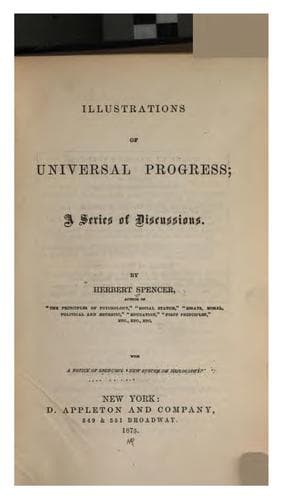
Illustrations of Universal Progress: A Series of DiscussionsSpencer, Herbert
Philosophy
Illustrations of Universal Progress: A Series of Discussions
Spencer, Herbert
Philosophy; Political science; Science
Whoever has studied the physiognomy of political meetings, cannot fail to
have remarked a connection between democratic opinions and peculiarities of
costume. At a Chartist demonstration, a lecture on Socialism, or a _soiree_
of the Friends of Italy, there will be seen many among the audience, and a
still larger ratio among the speakers, who get themselves up in a style
more or less unusual. One gentleman on the platform divides his hair down
the centre, instead of on one side; another brushes it back off the
forehead, in the fashion known as "bringing out the intellect;" a third has
so long forsworn the scissors, that his locks sweep his shoulders. A
considerable sprinkling of moustaches may be observed; here and there an
imperial; and occasionally some courageous breaker of conventions exhibits
a full-grown beard.[E] This nonconformity in hair is countenanced by
various nonconformities in dress, shown by others of the assemblage. Bare
necks, shirt-collars _a la_ Byron, waistcoats cut Quaker fashion,
wonderfully shaggy great coats, numerous oddities in form and colour,
destroy the monotony usual in crowds. Even those exhibiting no conspicuous
peculiarity, frequently indicate by something in the pattern or make-up of
their clothes, that they pay small regard to what their tailors tell them
about the prevailing taste. And when the gathering breaks up, the varieties
of head gear displayed--the number of caps, and the abundance of felt
hats--suffice to prove that were the world at large like-minded, the black
cylinders which tyrannize over us would soon be deposed.
[E] This was written before moustaches and beards had become common.
The foreign correspondence of our daily press shows that this relationship
between political discontent and the disregard of customs exists on the
Continent also. Red republicanism has always been distinguished by its
hirsuteness. The authorities of Prussia, Austria, and Italy, alike
recognize certain forms of hat as indicative of disaffection, and fulminate
against them accordingly. In some places the wearer of a blouse runs a risk
of being classed among the _suspects_; and in others, he who would avoid
the bureau of police, must beware how he goes out in any but the ordinary
colours. Thus, democracy abroad, as at home, tends towards personal
singularity.
Public-domain text, read in full here on John Shaqi.
Reviews
Reviews
No reviews yet
Be the first to share your thoughts on this work.
Elsewhere in the archive
Join the Discussion
Join the discussion
Sign in to leave a comment or review.
Sign InorCreate an account