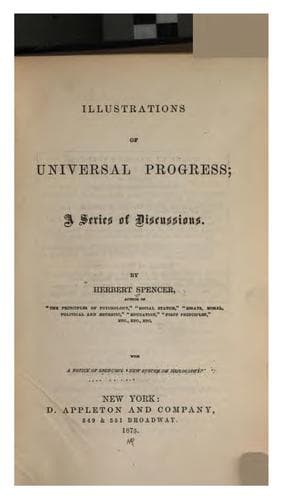
Illustrations of Universal Progress: A Series of DiscussionsSpencer, Herbert
Philosophy
Illustrations of Universal Progress: A Series of Discussions
Spencer, Herbert
Philosophy; Political science; Science
Nor is this association of characteristics peculiar to modern times, or to
reformers of the State. It has always existed; and it has been manifested
as much in religious agitations as in political ones. Along with dissent
from the chief established opinions and arrangements, there has ever been
some dissent from the customary social practices. The Puritans,
disapproving of the long curls of the Cavaliers, as of their principles,
cut their own hair short, and so gained the name of "Roundheads." The
marked religious nonconformity of the Quakers was accompanied by an
equally-marked nonconformity of manners--in attire, in speech, in
salutation. The early Moravians not only believed differently, but at the
same time dressed differently, and lived differently, from their fellow
Christians.
That the association between political independence and independence of
personal conduct, is not a phenomenon of to-day only, we may see alike in
the appearance of Franklin at the French court in plain clothes, and in the
white hats worn by the last generation of radicals. Originality of nature
is sure to show itself in more ways than one. The mention of George Fox's
suit of leather, or Pestalozzi's school name, "Harry Oddity," will at once
suggest the remembrance that men who have in great things diverged from the
beaten track, have frequently done so in small things likewise. Minor
illustrations of this truth may be gathered in almost every circle. We
believe that whoever will number up his reforming and rationalist
acquaintances, will find among them more than the usual proportion of those
who in dress or behaviour exhibit some degree of what the world calls
eccentricity.
If it be a fact that men of revolutionary aims in politics or religion, are
commonly revolutionists in custom also, it is not less a fact that those
whose office it is to uphold established arrangements in State and Church,
are also those who most adhere to the social forms and observances
bequeathed to us by past generations. Practices elsewhere extinct still
linger about the headquarters of government. The monarch still gives assent
to Acts of Parliament in the old French of the Normans; and Norman French
terms are still used in law. Wigs, such as those we see depicted in old
portraits, may yet be found on the heads of judges and barristers. The
Beefeaters at the Tower wear the costume of Henry VIIth's body-guard. The
University dress of the present year varies but little from that worn soon
after the Reformation. The claret-coloured coat, knee-breeches, lace shirt
frills, ruffles, white silk stockings, and buckled shoes, which once formed
the usual attire of a gentleman, still survive as the court-dress. And it
need scarcely be said that at _levees_ and drawing-rooms, the ceremonies
are prescribed with an exactness, and enforced with a rigour, not elsewhere
to be found.
Public-domain text, read in full here on John Shaqi.
Reviews
Reviews
No reviews yet
Be the first to share your thoughts on this work.
Elsewhere in the archive
Join the Discussion
Join the discussion
Sign in to leave a comment or review.
Sign InorCreate an account