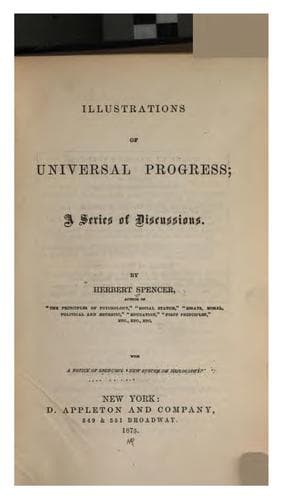
Illustrations of Universal Progress: A Series of DiscussionsSpencer, Herbert
Philosophy
Illustrations of Universal Progress: A Series of Discussions
Spencer, Herbert
Philosophy; Political science; Science
That Law, Religion, and Manners are thus related--that their respective
kinds of operation come under one generalization--that they have in certain
contrasted characteristics of men a common support and a common
danger--will, however, be most clearly seen on discovering that they have a
common origin. Little as from present appearances we should suppose it, we
shall yet find that at first, the control of religion, the control of laws,
and the control of manners, were all one control. However incredible it may
now seem, we believe it to be demonstrable that the rules of etiquette, the
provisions of the statute-book, and the commands of the decalogue, have
grown from the same root. If we go far enough back into the ages of
primeval Fetishism, it becomes manifest that originally Deity, Chief, and
Master of the ceremonies were identical. To make good these positions, and
to show their bearing on what is to follow, it will be necessary here to
traverse ground that is in part somewhat beaten, and at first sight
irrelevant to our topic. We will pass over it as quickly as consists with
the exigencies of the argument.
* * * * *
That the earliest social aggregations were ruled solely by the will of the
strong man, few dispute. That from the strong man proceeded not only
Monarchy, but the conception of a God, few admit: much as Carlyle and
others have said in evidence of it. If, however, those who are unable to
believe this, will lay aside the ideas of God and man in which they have
been educated, and study the aboriginal ideas of them, they will at least
see some probability in the hypothesis. Let them remember that before
experience had yet taught men to distinguish between the possible and the
impossible; and while they were ready on the slightest suggestion to
ascribe unknown powers to any object and make a fetish of it; their
conceptions of humanity and its capacities were necessarily vague, and
without specific limits. The man who by unusual strength, or cunning,
achieved something that others had failed to achieve, or something which
they did not understand, was considered by them as differing from
themselves; and, as we see in the belief of some Polynesians that only
their chiefs have souls, or in that of the ancient Peruvians that their
nobles were divine by birth, the ascribed difference was apt to be not one
of degree only, but one of kind.
Public-domain text, read in full here on John Shaqi.
Reviews
Reviews
No reviews yet
Be the first to share your thoughts on this work.
Elsewhere in the archive
Join the Discussion
Join the discussion
Sign in to leave a comment or review.
Sign InorCreate an account