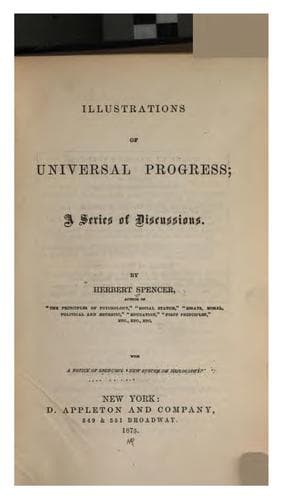
Illustrations of Universal Progress: A Series of DiscussionsSpencer, Herbert
Philosophy
Illustrations of Universal Progress: A Series of Discussions
Spencer, Herbert
Philosophy; Political science; Science
Let them remember next, how gross were the notions of God, or rather of
gods, prevalent during the same era and afterwards--how concretely gods
were conceived as men of specific aspects dressed in specific ways--how
their names were literally "the strong," "the destroyer," "the powerful
one,"--how, according to the Scandinavian mythology, the "sacred duty of
blood-revenge" was acted on by the gods themselves,--and how they were not
only human in their vindictiveness, their cruelty, and their quarrels with
each other, but were supposed to have amours on earth, and to consume the
viands placed on their altars. Add to which, that in various mythologies,
Greek, Scandinavian, and others, the oldest beings are giants; that
according to a traditional genealogy the gods, demi-gods, and in some cases
men, are descended from these after the human fashion; and that while in
the East we hear of sons of God who saw the daughters of men that they were
fair, the Teutonic myths tell of unions between the sons of men and the
daughters of the gods.
Let them remember, too, that at first the idea of death differed widely
from that which we have; that there are still tribes who, on the decease of
one of their number, attempt to make the corpse stand, and put food into
his mouth; that the Peruvians had feasts at which the mummies of their dead
Incas presided, when, as Prescott says, they paid attention "to these
insensible remains as if they were instinct with life;" that among the
Feejees it is believed that every enemy has to be killed twice; that the
Eastern Pagans give extension and figure to the soul, and attribute to it
all the same substances, both solid and liquid, of which our bodies are
composed; and that it is the custom among most barbarous races to bury
food, weapons, and trinkets along with the dead body, under the manifest
belief that it will presently need them.
Lastly, let them remember that the other world, as originally conceived, is
simply some distant part of this world--some Elysian fields, some happy
hunting-ground, accessible even to the living, and to which, after death,
men travel in anticipation of a life analogous in general character to that
which they led before. Then, co-ordinating these general facts--the
ascription of unknown powers to chiefs and medicine men; the belief in
deities having human forms, passions, and behaviour; the imperfect
comprehension of death as distinguished from life; and the proximity of the
future abode to the present, both in position and character--let them
reflect whether they do not almost unavoidably suggest the conclusion that
the aboriginal god is the dead chief: the chief not dead in our sense, but
gone away carrying with him food and weapons to some rumoured region of
plenty, some promised land, whither he had long intended to lead his
followers, and whence he will presently return to fetch them.
Public-domain text, read in full here on John Shaqi.
Reviews
Reviews
No reviews yet
Be the first to share your thoughts on this work.
Elsewhere in the archive
Join the Discussion
Join the discussion
Sign in to leave a comment or review.
Sign InorCreate an account