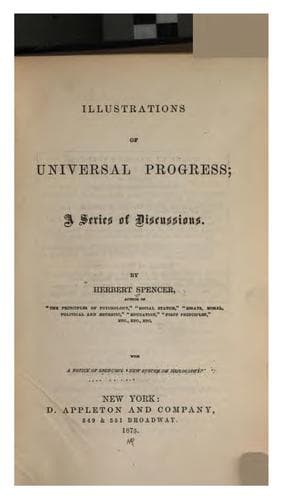
Illustrations of Universal Progress: A Series of DiscussionsSpencer, Herbert
Philosophy
Illustrations of Universal Progress: A Series of Discussions
Spencer, Herbert
Philosophy; Political science; Science
All government, then, being originally that of the strong man who has
become a fetish by some manifestation of superiority, there arises, at his
death--his supposed departure on a long projected expedition, in which he
is accompanied by his slaves and concubines sacrificed at his tomb--there
arises, then, the incipient division of religious from political control,
of civil rule from spiritual. His son becomes deputed chief during his
absence; his authority is cited as that by which his son acts; his
vengeance is invoked on all who disobey his son; and his commands, as
previously known or as asserted by his son, become the germ of a moral
code: a fact we shall the more clearly perceive if we remember, that early
moral codes inculcate mainly the virtues of the warrior, and the duty of
exterminating some neighbouring tribe whose existence is an offence to the
deity.
From this point onwards, these two kinds of authority, at first complicated
together as those of principal and agent, become slowly more and more
distinct. As experience accumulates, and ideas of causation grow more
precise, kings lose their supernatural attributes; and, instead of
God-king, become God-descended king, God-appointed king, the Lord's
anointed, the viceregent of heaven, ruler reigning by Divine right. The old
theory, however, long clings to men in feeling, after it has disappeared in
name; and "such divinity doth hedge a king," that even now, many, on first
seeing one, feel a secret surprise at finding him an ordinary sample of
humanity. The sacredness attaching to royalty attaches afterwards to its
appended institutions--to legislatures, to laws. Legal and illegal are
synonymous with right and wrong; the authority of Parliament is held
unlimited; and a lingering faith in governmental power continually
generates unfounded hopes from its enactments. Political scepticism,
however, having destroyed the divine _prestige_ of royalty, goes on ever
increasing, and promises ultimately to reduce the State to a purely secular
institution, whose regulations are limited in their sphere, and have no
other authority than the general will. Meanwhile, the religious control has
been little by little separating itself from the civil, both in its essence
and in its forms. While from the God-king of the savage have arisen in one
direction, secular rulers who, age by age, have been losing the sacred
attributes men ascribed to them; there has arisen in another direction, the
conception of a deity, who, at first human in all things, has been
gradually losing human materiality, human form, human passions, human modes
of action: until now, anthropomorphism has become a reproach.
Public-domain text, read in full here on John Shaqi.
Reviews
Reviews
No reviews yet
Be the first to share your thoughts on this work.
Elsewhere in the archive
Join the Discussion
Join the discussion
Sign in to leave a comment or review.
Sign InorCreate an account