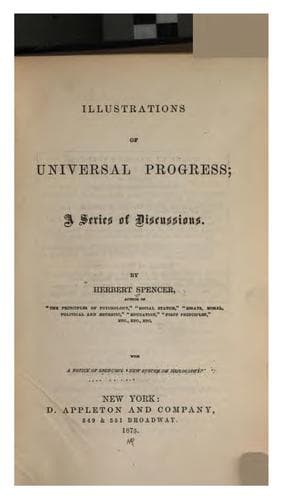
Illustrations of Universal Progress: A Series of DiscussionsSpencer, Herbert
Philosophy
Illustrations of Universal Progress: A Series of Discussions
Spencer, Herbert
Philosophy; Political science; Science
Along with this wide divergence in men's ideas of the divine and civil
ruler has been taking place a corresponding divergence in the codes of
conduct respectively proceeding from them. While the king was a
deputy-god--a governor such as the Jews looked for in the Messiah--a
governor considered, as the Czar still is, "our God upon Earth,"--it, of
course, followed that his commands were the supreme rules. But as men
ceased to believe in his supernatural origin and nature, his commands
ceased to be the highest; and there arose a distinction between the
regulations made by him, and the regulations handed down from the old
god-kings, who were rendered ever more sacred by time and the accumulation
of myths. Hence came respectively, Law and Morality: the one growing ever
more concrete, the other more abstract; the authority of the one ever on
the decrease, that of the other ever on the increase; originally the same,
but now placed daily in more marked antagonism.
Simultaneously there has been going on a separation of the institutions
administering these two codes of conduct. While they were yet one, of
course Church and State were one: the king was arch-priest, not nominally,
but really--alike the giver of new commands and the chief interpreter of
the old commands; and the deputy-priests coming out of his family were thus
simply expounders of the dictates of their ancestry: at first as
recollected, and afterwards as ascertained by professed interviews with
them. This union--which still existed practically during the middle ages,
when the authority of kings was mixed up with the authority of the pope,
when there were bishop-rulers having all the powers of feudal lords, and
when priests punished by penances--has been, step by step, becoming less
close. Though monarchs are still "defenders of the faith," and
ecclesiastical chiefs, they are but nominally such. Though bishops still
have civil power, it is not what they once had. Protestantism shook loose
the bonds of union; Dissent has long been busy in organizing a mechanism
for the exercise of religious control, wholly independent of law; in
America, a separate organization for that purpose already exists; and if
anything is to be hoped from the Anti-State-Church Association--or, as it
has been newly named, "The Society for the Liberation of Religion from
State Patronage and Control"--we shall presently have a separate
organization here also.
Thus alike in authority, in essence, and in form, political and spiritual
rule have been ever more widely diverging from the same root. That
increasing division of labour which marks the progress of society in other
things, marks it also in this separation of government into civil and
religious; and if we observe how the morality which forms the substance of
religions in general, is beginning to be purified from the associated
creeds, we may anticipate that this division will be ultimately carried
much further.
Public-domain text, read in full here on John Shaqi.
Reviews
Reviews
No reviews yet
Be the first to share your thoughts on this work.
Elsewhere in the archive
Join the Discussion
Join the discussion
Sign in to leave a comment or review.
Sign InorCreate an account