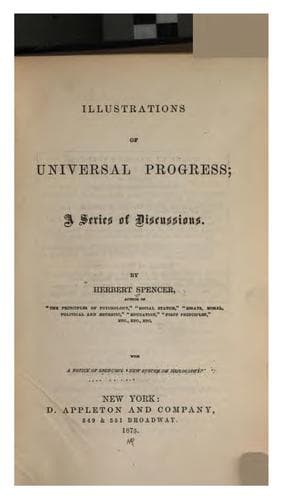
Illustrations of Universal Progress: A Series of DiscussionsSpencer, Herbert
Philosophy
Illustrations of Universal Progress: A Series of Discussions
Spencer, Herbert
Philosophy; Political science; Science
There is reason to think that these titles were originally proper names.
Not only do we see among the Egyptians, where Pharaoh was synonymous with
king, and among the Romans, where to be Caesar, meant to be Emperor, that
the proper names of the greatest men were transferred to their successors,
and so became class names; but in the Scandinavian mythology we may trace a
human title of honour up to the proper name of a divine personage. In
Anglo-Saxon _bealdor_, or _baldor_, means _Lord_; and Balder is the name of
the favourite of Odin's sons--the gods who with him constitute the Teutonic
Pantheon. How these names of honour became general is easily understood.
The relatives of the primitive kings--the grandees described by Selden as
having names formed on those of the gods, and shown by this to be members
of the divine race--necessarily shared in the epithets, such as _Lord_,
descriptive of superhuman relationships and nature. Their ever-multiplying
offspring inheriting these, gradually rendered them comparatively common.
And then they came to be applied to every man of power: partly from the
fact that, in these early days when men conceived divinity simply as a
stronger kind of humanity, great persons could be called by divine epithets
with but little exaggeration; partly from the fact that the unusually
potent were apt to be considered as unrecognized or illegitimate
descendants of "the strong, the destroyer, the powerful one;" and partly,
also, from compliment and the desire to propitiate.
Progressively as superstition diminished, this last became the sole cause.
And if we remember that it is the nature of compliment, as we daily hear
it, to attribute more than is due--that in the constantly widening
application of "esquire," in the perpetual repetition of "your honour" by
the fawning Irishman, and in the use of the name "gentleman" to any
coalheaver or dustman by the lower classes of London, we have current
examples of the depreciation of titles consequent on compliment--and that
in barbarous times, when the wish to propitiate was stronger than now, this
effect must have been greater; we shall see that there naturally arose an
extensive misuse of all early distinctions. Hence the facts, that the Jews
called Herod a god; that _Father_, in its higher sense, was a term used
among them by servants to masters; that _Lord_ was applicable to any person
of worth and power. Hence, too, the fact that, in the later periods of the
Roman Empire, every _ man saluted his neighbour as _Dominus_ and _Rex_.
Public-domain text, read in full here on John Shaqi.
Reviews
Reviews
No reviews yet
Be the first to share your thoughts on this work.
Elsewhere in the archive
Join the Discussion
Join the discussion
Sign in to leave a comment or review.
Sign InorCreate an account