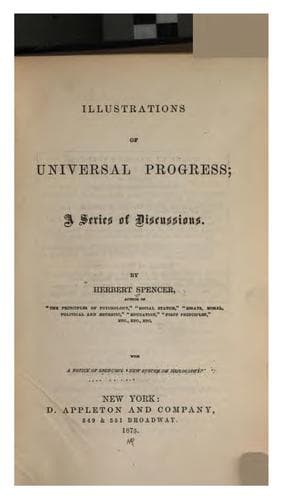
Illustrations of Universal Progress: A Series of DiscussionsSpencer, Herbert
Philosophy
Illustrations of Universal Progress: A Series of Discussions
Spencer, Herbert
Philosophy; Political science; Science
Further to illustrate this gradual depreciation of titles, and to confirm
the inference drawn, it may be well to notice in passing, that the oldest
of them have, as might be expected, been depreciated to the greatest
extent. Thus, _Master_--a word proved by its derivation and by the
similarity of the connate words in other languages (Fr., _maitre_ for
_master_; Russ., _master_; Dan., _meester_; Ger., _meister_) to have been
one of the earliest in use for expressing lordship--has now become
applicable to children only, and under the modification of "Mister," to
persons next above the labourer. Again, knighthood, the oldest kind of
dignity, is also the lowest; and Knight Bachelor, which is the lowest order
of knighthood, is more ancient than any other of the orders. Similarly,
too, with the peerage: Baron is alike the earliest and least elevated of
its divisions. This continual degradation of all names of honor has, from
time to time, made it requisite to introduce new ones having that
distinguishing effect which the originals had lost by generality of use;
just as our habit of misapplying superlatives has, by gradually destroying
their force, entailed the need for fresh ones. And if, within the last
thousand years, this process has produced effects thus marked, we may
readily conceive how, during previous thousands, the titles of gods and
demi-gods came to be used to all persons exercising power; as they have
since come to be used to persons of respectability.
If from names of honour we turn to phrases of honour, we find similar
facts. The Oriental styles of address, applied to ordinary people--"I am
your slave," "All I have is yours," "I am your sacrifice"--attribute to the
individual spoken to the same greatness that _Monsieur_ and _My Lord_ do:
they ascribe to him the character of an all-powerful ruler, so immeasurably
superior to the speaker as to be his owner. So, likewise, with the Polish
expressions of respect--"I throw myself under your feet," "I kiss your
feet." In our now meaningless subscription to a formal letter--"Your most
obedient servant,"--the same thing is visible. Nay, even in the familiar
signature "Yours faithfully," the "yours," if interpreted as originally
meant, is the expression of a slave to his master.
Public-domain text, read in full here on John Shaqi.
Reviews
Reviews
No reviews yet
Be the first to share your thoughts on this work.
Elsewhere in the archive
Join the Discussion
Join the discussion
Sign in to leave a comment or review.
Sign InorCreate an account