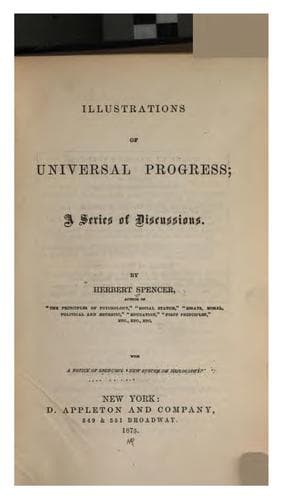
Illustrations of Universal Progress: A Series of DiscussionsSpencer, Herbert
Philosophy
Illustrations of Universal Progress: A Series of Discussions
Spencer, Herbert
Philosophy; Political science; Science
The same may be said, too, of the curtsy, or courtesy, as it is otherwise
written. Its derivation from _courtoisie_, courteousness, that is,
behaviour like that at court, at once shows that it was primarily the
reverence paid to a monarch. And if we call to mind that falling upon the
knees, or upon one knee, has been a common obeisance of subjects to rulers;
that in ancient manuscripts and tapestries, servants are depicted as
assuming this attitude while offering the dishes to their masters at table;
and that this same attitude is assumed towards our own queen at every
presentation; we may infer, what the character of the curtsy itself
suggests, that it is an abridged act of kneeling. As the word has been
contracted from _courtoisie_ into curtsy; so the motion has been contracted
from a placing of the knee on the floor, to a lowering of the knee towards
the floor. Moreover, when we compare the curtsy of a lady with the awkward
one a peasant girl makes, which, if continued, would bring her down on both
knees, we may see in this last a remnant of that greater reverence required
of serfs. And when, from considering that simple kneeling of the West,
still represented by the curtsy, we pass Eastward, and note the attitude of
the Mahomedan worshipper, who not only kneels but bows his head to the
ground, we may infer that the curtsy also, is an evanescent form of the
aboriginal prostration.
In further evidence of this it may be remarked, that there has but recently
disappeared from the salutations of men, an action having the same
proximate derivation with the curtsy. That backward sweep of the foot with
which the conventional stage-sailor accompanies his bow--a movement which
prevailed generally in past generations, when "a bow and a scrape" went
together, and which, within the memory of living persons, was made by boys
to their schoolmaster with the effect of wearing a hole in the floor--is
pretty clearly a preliminary to going on one knee. A motion so ungainly
could never have been intentionally introduced; even if the artificial
introduction of obeisances were possible. Hence we must regard it as the
remnant of something antecedent: and that this something antecedent was
humiliating maybe inferred from the phrase, "scraping an acquaintance;"
which, being used to denote the gaining of favour by obsequiousness,
implies that the scrape was considered a mark of servility--that is, of
_serf_-ility.
Public-domain text, read in full here on John Shaqi.
Reviews
Reviews
No reviews yet
Be the first to share your thoughts on this work.
Elsewhere in the archive
Join the Discussion
Join the discussion
Sign in to leave a comment or review.
Sign InorCreate an account