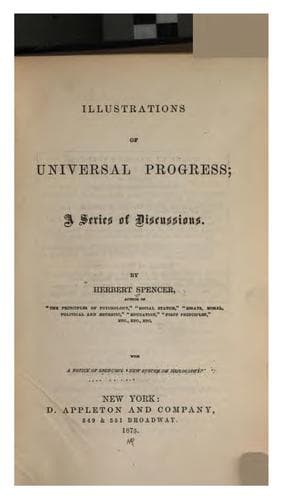
Illustrations of Universal Progress: A Series of DiscussionsSpencer, Herbert
Philosophy
Illustrations of Universal Progress: A Series of Discussions
Spencer, Herbert
Philosophy; Political science; Science
Consider, again, the uncovering of the head. Almost everywhere this has
been a sign of reverence, alike in temples and before potentates; and it
yet preserves among us some of its original meaning. Whether it rains,
hails, or shines, you must keep your head bare while speaking to the
monarch; and on no plea may you remain covered in a place of worship. As
usual, however, this ceremony, at first a submission to gods and kings, has
become in process of time a common civility. Once an acknowledgment of
another's unlimited supremacy, the removal of the hat is now a salute
accorded to very ordinary persons, and that uncovering, originally reserved
for entrance into "the house of God," good manners now dictates on entrance
into the house of a common labourer.
Standing, too, as a mark of respect, has undergone like extensions in its
application. Shown, by the practice in our churches, to be intermediate
between the humiliation signified by kneeling and the self-respect which
sitting implies, and used at courts as a form of homage when more active
demonstrations of it have been made, this posture is now employed in daily
life to show consideration; as seen alike in the attitude of a servant
before a master, and in that rising which politeness prescribes on the
entrance of a visitor.
Many other threads of evidence might have been woven into our argument. As,
for example, the significant fact, that if we trace back our still existing
law of primogeniture--if we consider it as displayed by Scottish clans, in
which not only ownership but government devolved from the beginning on the
eldest son of the eldest--if we look further back, and observe that the old
titles of lordship, _Signor_, _Seigneur_, _Sennor_, _Sire_, _Sieur_, all
originally mean, senior, or elder--if we go Eastward, and find that
_Sheick_ has a like derivation, and that the Oriental names for priests, as
_Pir_, for instance, are literally interpreted _old man_--if we note in
Hebrew records how primeval is the ascribed superiority of the first-born,
how great the authority of elders, and how sacred the memory of
patriarchs--and if, then, we remember that among divine titles are "Ancient
of Days," and "Father of Gods and men;"--we see how completely these facts
harmonize with the hypothesis, that the aboriginal god is the first man
sufficiently great to become a tradition, the earliest whose power and
deeds made him remembered; that hence antiquity unavoidably became
associated with superiority, and age with nearness in blood to "the
powerful one;" that so there naturally arose that domination of the eldest
which characterizes all history, and that theory of human degeneracy which
even yet survives.
Public-domain text, read in full here on John Shaqi.
Reviews
Reviews
No reviews yet
Be the first to share your thoughts on this work.
Elsewhere in the archive
Join the Discussion
Join the discussion
Sign in to leave a comment or review.
Sign InorCreate an account