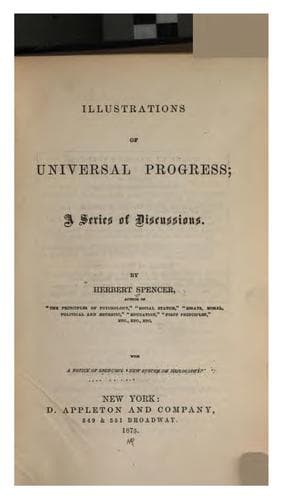
Illustrations of Universal Progress: A Series of Discussions — John Shaqi
Illustrations of Universal Progress: A Series of DiscussionsSpencer, Herbert
Philosophy
Illustrations of Universal Progress: A Series of Discussions
Spencer, Herbert
Philosophy; Political science; Science
Lastly, in Part Fifth, Mr. Spencer proposes to consider the _Principles of
Morality_, bringing to bear the truths furnished by Biology, Psychology,
and Sociology, to determine the true theory of right living. He will show
that the true moral ideal and limit of progress is the attainment of an
equilibrium between constitution and conditions of existence, and trace
those principles of private conduct, physical, intellectual, moral, and
religious that follow from the conditions to complete individual life.
Those rules of human action which all civilized nations have registered as
essential laws--the inductions of morality--will be delineated, and also
those mutual limitations of men's actions necessitated by their coexistence
as units of society, which constitute the foundation of justice.
* * * * *
It cannot be doubted that the order here indicated, as it corresponds to
the method of nature, is the one which Philosophy must pursue in the
future. It combines the precision of science with the harmony and unity of
universal truth. The time is past when Biology can be considered with no
reference to the laws of Physics; Mind with no reference to the science of
Life, and Sociology, without having previously mastered the foregoing
subjects. The progress of knowledge is now toward more definite,
systematic, and comprehensive views, while it is the highest function of
intellect to coordinate and bind together its isolated and fragmentary
parts. In carrying out his great plan, therefore, Mr. Spencer is but
embodying the large philosophical tendencies of the age.
If it is urged that his scheme is too vast for any one man to accomplish,
it may be replied: 1st. That it is not intended to treat the various
subjects exhaustively, but only to state general principles with just
sufficient details for their clear illustration. 2d. A considerable portion
of the work is already issued, and much more is ready for publication,
while the author is still in the prime of life. 3d. It must be remembered
that intellects occasionally appear, endowed with that comprehensive grasp
and high organizing power which fits them for vast undertakings. The reader
will find at the close of the volume Mr. Spencer's Prospectus of his
system. That he who has so clearly mapped out his work is the proper one to
execute it, we think will be fully apparent to all who peruse the present
volume.
An impression prevails with many that Mr. Spencer belongs to the positive
school of M. Auguste Comte. This is an entire misapprehension; but the
position having been assumed by several of his reviewers, he repels the
charge in the following letter, which appeared in the _New Englander_ for
January, 1864.
_To the Editor of the New Englander_:
Public-domain text, read in full here on John Shaqi.
Reviews
Reviews
No reviews yet
Be the first to share your thoughts on this work.
Join the Discussion
Join the discussion
Sign in to leave a comment or review.
Sign InorCreate an account