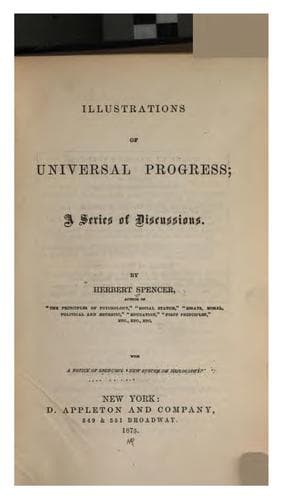
Illustrations of Universal Progress: A Series of DiscussionsSpencer, Herbert
Philosophy
Illustrations of Universal Progress: A Series of Discussions
Spencer, Herbert
Philosophy; Political science; Science
Thus the general doctrine, that all kinds of government exercised over men
were at first one government--that the political, the religious, and the
ceremonial forms of control are divergent branches of a general and once
indivisible control--begins to look tenable. When, with the above facts
fresh in mind, we read primitive records, and find that "there were giants
in those days"--when we remember that in Eastern traditions Nimrod, among
others, figures in all the characters of giant, king, and divinity--when we
turn to the sculptures exhumed by Mr. Layard, and contemplating in them the
effigies of kings driving over enemies, trampling on prisoners, and adored
by prostrate slaves, then observe how their actions correspond to the
primitive names for the divinity, "the strong," "the destroyer," "the
powerful one"--when we find that the earliest temples were also the
residences of the kings--and when, lastly, we discover that among races of
men still living, there are current superstitions analogous to those which
old records and old buildings indicate; we begin to realize the probability
of the hypothesis that has been set forth.
Going back, in imagination, to the remote era when men's theories of things
were yet unformed; and conceiving to ourselves the conquering chief as
dimly figured in ancient myths, and poems, and ruins; we may see that all
rules of conduct whatever spring from his will. Alike legislator and judge,
all quarrels among his subjects are decided by him; and his words become
the Law. Awe of him is the incipient Religion; and his maxims furnish its
first precepts. Submission is made to him in the forms he prescribes; and
these give birth to Manners. From the first, time develops political
allegiance and the administration of justice; from the second, the worship
of a being whose personality becomes ever more vague, and the inculcation
of precepts ever more abstract; from the third, forms of honour and the
rules of etiquette.
Public-domain text, read in full here on John Shaqi.
Reviews
Reviews
No reviews yet
Be the first to share your thoughts on this work.
Elsewhere in the archive
Join the Discussion
Join the discussion
Sign in to leave a comment or review.
Sign InorCreate an account