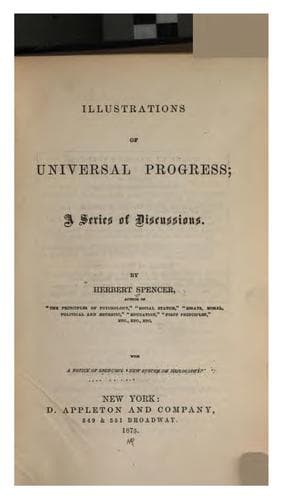
Illustrations of Universal Progress: A Series of DiscussionsSpencer, Herbert
Philosophy
Illustrations of Universal Progress: A Series of Discussions
Spencer, Herbert
Philosophy; Political science; Science
In conformity with the law of evolution of all organized bodies, that
general functions are gradually separated into the special functions
constituting them, there have grown up in the social organism for the
better performance of the governmental office, an apparatus of law-courts,
judges, and barristers; a national church, with its bishops and priests;
and a system of caste, titles, and ceremonies, administered by society at
large. By the first, overt aggressions are cognized and punished; by the
second, the disposition to commit such aggressions is in some degree
checked; by the third, those minor breaches of good conduct, which the
others do not notice, are denounced and chastised. Law and Religion control
behaviour in its essentials: Manners control it in its details. For
regulating those daily actions which are too numerous and too unimportant
to be officially directed, there comes into play this subtler set of
restraints. And when we consider what these restraints are--when we analyze
the words, and phrases, and salutes employed, we see that in origin as in
effect, the system is a setting up of temporary governments between all men
who come in contact, for the purpose of better managing the intercourse
between them.
* * * * *
From the proposition, that these several kinds of government are
essentially one, both in genesis and function, may be deduced several
important corollaries, directly bearing on our special topic.
Let us first notice, that there is not only a common origin and office for
all forms of rule, but a common necessity for them. The aboriginal man,
coming fresh from the killing of bears and from lying in ambush for his
enemy, has, by the necessities of his condition, a nature requiring to be
curbed in its every impulse. Alike in war and in the chase, his daily
discipline has been that of sacrificing other creatures to his own needs
and passions. His character, bequeathed to him by ancestors who led similar
lives, is moulded by this discipline--is fitted to this existence. The
unlimited selfishness, the love of inflicting pain, the bloodthirstiness,
thus kept active, he brings with him into the social state. These
dispositions put him in constant danger of conflict with his equally savage
neighbour. In small things as in great, in words as in deeds, he is
aggressive; and is hourly liable to the aggressions of others like natured.
Only, therefore, by the most rigorous control exercised over all actions,
can the primitive unions of men be maintained. There must be a ruler
strong, remorseless, and of indomitable will; there must be a creed
terrible in its threats to the disobedient; and there must be the most
servile submission of all inferiors to superiors. The law must be cruel;
the religion must be stern; the ceremonies must be strict.
Public-domain text, read in full here on John Shaqi.
Reviews
Reviews
No reviews yet
Be the first to share your thoughts on this work.
Elsewhere in the archive
Join the Discussion
Join the discussion
Sign in to leave a comment or review.
Sign InorCreate an account