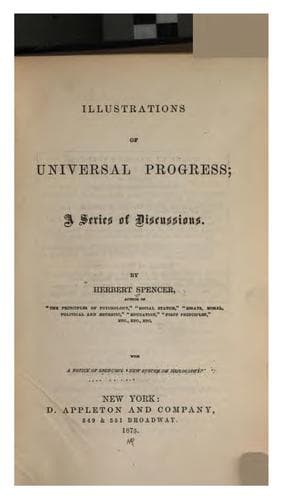
Illustrations of Universal Progress: A Series of DiscussionsSpencer, Herbert
Philosophy
Illustrations of Universal Progress: A Series of Discussions
Spencer, Herbert
Philosophy; Political science; Science
The co-ordinate necessity for these several kinds of restraint might be
largely illustrated from history were there space. Suffice it to point out,
that where the civil power has been weak, the multiplication of thieves,
assassins, and banditti, has indicated the approach of social dissolution;
that when, from the corruptness of its ministry, religion has lost its
influence, as it did just before the Flagellants appeared, the State has
been endangered; and that the disregard of established social observances
has ever been an accompaniment of political revolutions. Whoever doubts the
necessity for a government of manners proportionate in strength to the
co-existing political and religious governments, will be convinced on
calling to mind that until recently even elaborate codes of behaviour
failed to keep gentlemen from quarrelling in the streets and fighting duels
in taverns; and on remembering further, that even now people exhibit at the
doors of a theatre, where there is no ceremonial law to rule them, a degree
of aggressiveness which would produce confusion if carried into social
intercourse.
As might be expected, we find that, having a common origin and like general
functions, these several controlling agencies act during each era with
similar degrees of vigour. Under the Chinese despotism, stringent and
multitudinous in its edicts and harsh in the enforcement of them, and
associated with which there is an equally stern domestic despotism
exercised by the eldest surviving male of the family, there exists a system
of observances alike complicated and rigid. There is a tribunal of
ceremonies. Previous to presentation at court, ambassadors pass many days
in practising the required forms. Social intercourse is cumbered by endless
compliments and obeisances. Class distinctions are strongly marked by
badges. The chief regret on losing an only son is, that there will be no
one to perform the sepulchral rites. And if there wants a definite measure
of the respect paid to social ordinances, we have it in the torture to
which ladies submit in having their feet crushed. In India, and indeed
throughout the East, there exists a like connection between the pitiless
tyranny of rulers, the dread terrors of immemorial creeds, and the rigid
restraint of unchangeable customs: the caste regulations continue still
unalterable; the fashions of clothes and furniture have remained the same
for ages; suttees are so ancient as to be mentioned by Strabo and Diodorus
Siculus; justice is still administered at the palace-gates as of old; in
short, "every usage is a precept of religion and a maxim of jurisprudence."
Public-domain text, read in full here on John Shaqi.
Reviews
Reviews
No reviews yet
Be the first to share your thoughts on this work.
Elsewhere in the archive
Join the Discussion
Join the discussion
Sign in to leave a comment or review.
Sign InorCreate an account