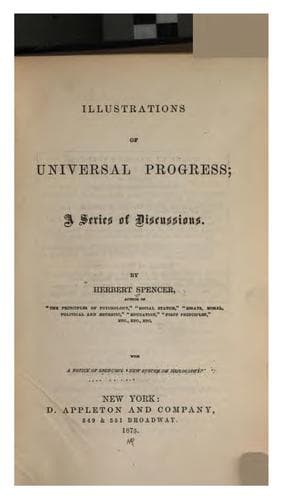
Illustrations of Universal Progress: A Series of DiscussionsSpencer, Herbert
Philosophy
Illustrations of Universal Progress: A Series of Discussions
Spencer, Herbert
Philosophy; Political science; Science
As already implied, this association of facts is not accidental. These
titles of address and modes of salutation, bearing about them, as they all
do, something of that servility which marks their origin, become
distasteful in proportion as men become more independent themselves, and
sympathise more with the independence of others. The feeling which makes
the modern gentleman tell the labourer standing bareheaded before him to
put on his hat--the feeling which gives us a dislike to those who cringe
and fawn--the feeling which makes us alike assert our own dignity and
respect that of others--the feeling which thus leads us more and more to
discountenance all forms and names which confess inferiority and
submission; is the same feeling which resists despotic power and
inaugurates popular government, denies the authority of the Church and
establishes the right of private judgment.
A fourth fact, akin to the foregoing, is, that these several kinds of
government not only decline together, but corrupt together. By the same
process that a Court of Chancery becomes a place not for the administration
of justice, but for the withholding of it--by the same process that a
national church, from being an agency for moral control, comes to be merely
a thing of formulas and tithes and bishoprics--by this same process do
titles and ceremonies that once had a meaning and a power become empty
forms.
Coats of arms which served to distinguish men in battle, now figure on the
carriage panels of retired grocers. Once a badge of high military rank, the
shoulder-knot has become, on the modern footman, a mark of servitude. The
name Banneret, which once marked a partially-created Baron--a Baron who had
passed his military "little go"--is now, under the modification of Baronet,
applicable to any one favoured by wealth or interest or party feeling.
Knighthood has so far ceased to be an honour, that men now honour
themselves by declining it. The military dignity _Escuyer_ has, in the
modern Esquire, become a wholly unmilitary affix. Not only do titles, and
phrases, and salutes cease to fulfil their original functions, but the
whole apparatus of social forms tends to become useless for its original
purpose--the facilitation of social intercourse. Those most learned in
ceremonies, and most precise in the observance of them, are not always the
best behaved; as those deepest read in creeds and scriptures are not
therefore the most religious; nor those who have the clearest notions of
legality and illegality, the most honest. Just as lawyers are of all men
the least noted for probity; as cathedral towns have a lower moral
character than most others; so, if Swift is to be believed, courtiers are
"the most insignificant race of people that the island can afford, and with
the smallest tincture of good manners."
Public-domain text, read in full here on John Shaqi.
Reviews
Reviews
No reviews yet
Be the first to share your thoughts on this work.
Elsewhere in the archive
Join the Discussion
Join the discussion
Sign in to leave a comment or review.
Sign InorCreate an account