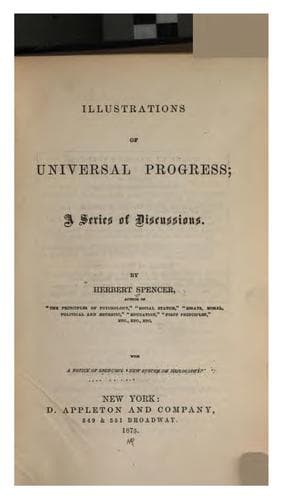
Illustrations of Universal Progress: A Series of DiscussionsSpencer, Herbert
Philosophy
Illustrations of Universal Progress: A Series of Discussions
Spencer, Herbert
Philosophy; Political science; Science
But perhaps it is in that class of social observances comprehended under
the term Fashion, which we must here discuss parenthetically, that this
process of corruption is seen with the greatest distinctness. As contrasted
with Manners, which dictate our minor acts in relation to other persons,
Fashion dictates our minor acts in relation to ourselves. While the one
prescribes that part of our deportment which directly affects our
neighbours; the other prescribes that part of our deportment which is
primarily personal, and in which our neighbours are concerned only as
spectators. Thus distinguished as they are, however, the two have a common
source. For while, as we have shown, Manners originate by imitation of the
behaviour pursued _towards_ the great; Fashion originates by imitation _of_
the behaviour of the great. While the one has its derivation in the titles,
phrases, and salutes used _to_ those in power; the other is derived from
the habits and appearances exhibited _by_ those in power.
The Carib mother who squeezes her child's head into a shape like that of
the chief; the young savage who makes marks on himself similar to the scars
carried by the warriors of his tribe (which is probably the origin of
tattooing); the Highlander who adopts the plaid worn by the head of his
clan; the courtiers who affect greyness, or limp, or cover their necks, in
imitation of their king; and the people who ape the courtiers; are alike
acting under a kind of government connate with that of Manners, and, like
it too, primarily beneficial. For notwithstanding the numberless
absurdities into which this copyism has led the people, from nose-rings to
ear-rings, from painted faces to beauty-spots, from shaven heads to
powdered wigs, from filed teeth and stained nails to bell-girdles, peaked
shoes, and breeches stuffed with bran,--it must yet be concluded, that as
the strong men, the successful men, the men of will, intelligence, and
originality, who have got to the top, are, on the average, more likely to
show judgment in their habits and tastes than the mass, the imitation of
such is advantageous.
Public-domain text, read in full here on John Shaqi.
Reviews
Reviews
No reviews yet
Be the first to share your thoughts on this work.
Elsewhere in the archive
Join the Discussion
Join the discussion
Sign in to leave a comment or review.
Sign InorCreate an account