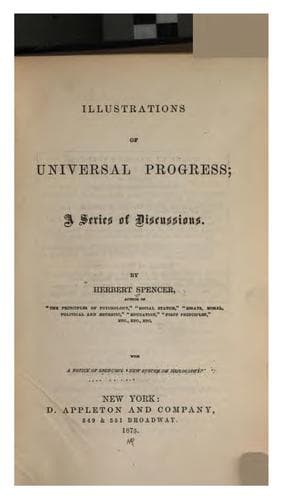
Illustrations of Universal Progress: A Series of DiscussionsSpencer, Herbert
Philosophy
Illustrations of Universal Progress: A Series of Discussions
Spencer, Herbert
Philosophy; Political science; Science
To these several corollaries--that the various orders of control exercised
over men have a common origin and a common function, are called out by
co-ordinate necessities and co-exist in like stringency, decline together
and corrupt together--it now only remains to add that they become needless
together. Consequent as all kinds of government are upon the unfitness of
the aboriginal man for social life; and diminishing in coerciveness as they
all do in proportion as this unfitness diminishes; they must one and all
come to an end as humanity acquires complete adaptation to its new
conditions. That discipline of circumstances which has already wrought out
such great changes in us, must go on eventually to work out yet greater
ones. That daily curbing of the lower nature and culture of the higher,
which out of cannibals and devil worshippers has evolved philanthropists,
lovers of peace, and haters of superstition, cannot fail to evolve out of
these, men as much superior to them as they are to their progenitors. The
causes that have produced past modifications are still in action; must
continue in action as long as there exists any incongruity between man's
desires and the requirements of the social state; and must eventually make
him organically fit for the social state. As it is now needless to forbid
man-eating and Fetishism, so will it ultimately become needless to forbid
murder, theft, and the minor offences of our criminal code. When human
nature has grown into conformity with the moral law, there will need no
judges and statute-books; when it spontaneously takes the right course in
all things, as in some things it does already, prospects of future reward
or punishment will not be wanted as incentives; and when fit behaviour has
become instinctive, there will need no code of ceremonies to say how
behaviour shall be regulated.
Thus, then, may be recognised the meaning, the naturalness, the necessity
of those various eccentricities of reformers which we set out by
describing. They are not accidental; they are not mere personal caprices,
as people are apt to suppose. On the contrary, they are inevitable results
of the law of relationship above illustrated. That community of genesis,
function, and decay which all forms of restraint exhibit, is simply the
obverse of the fact at first pointed out, that they have in two sentiments
of human nature a common preserver and a common destroyer. Awe of power
originates and cherishes them all: love of freedom undermines and
periodically weakens them all. The one defends despotism and asserts the
supremacy of laws, adheres to old creeds and supports ecclesiastical
authority, pays respect to titles and conserves forms; the other, putting
rectitude above legality, achieves periodical instalments of political
liberty, inaugurates Protestantism and works out its consequences, ignores
the senseless dictates of Fashion and emancipates men from dead customs.
Public-domain text, read in full here on John Shaqi.
Reviews
Reviews
No reviews yet
Be the first to share your thoughts on this work.
Elsewhere in the archive
Join the Discussion
Join the discussion
Sign in to leave a comment or review.
Sign InorCreate an account