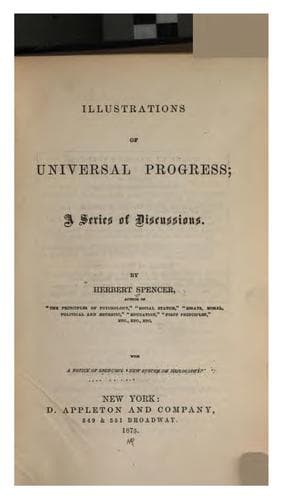
Illustrations of Universal Progress: A Series of DiscussionsSpencer, Herbert
Philosophy
Illustrations of Universal Progress: A Series of Discussions
Spencer, Herbert
Philosophy; Political science; Science
To the true reformer no institution is sacred, no belief above criticism.
Everything shall conform itself to equity and reason; nothing shall be
saved by its prestige. Conceding to each man liberty to pursue his own ends
and satisfy his own tastes, he demands for himself like liberty; and
consents to no restrictions on this, save those which other men's equal
claims involve. No matter whether it be an ordinance of one man, or an
ordinance of all men, if it trenches on his legitimate sphere of action, he
denies its validity. The tyranny that would impose on him a particular
style of dress and a set mode of behaviour, he resists equally with the
tyranny that would limit his buyings and sellings, or dictate his creed.
Whether the regulation be formally made by a legislature, or informally
made by society at large--whether the penalty for disobedience be
imprisonment, or frowns and social ostracism, he sees to be a question of
no moment. He will utter his belief notwithstanding the threatened
punishment; he will break conventions spite of the petty persecutions that
will be visited on him. Show him that his actions are inimical to his
fellow-men, and he will pause. Prove that he is disregarding their
legitimate claims--that he is doing what in the nature of things must
produce unhappiness; and he will alter his course. But until you do
this--until you demonstrate that his proceedings are essentially
inconvenient or inelegant, essentially irrational, unjust, or ungenerous,
he will persevere.
Some, indeed, argue that his conduct _is_ unjust and ungenerous. They say
that he has no right to annoy other people by his whims; that the gentleman
to whom his letter comes with no "Esq." appended to the address, and the
lady whose evening party he enters with gloveless hands, are vexed at what
they consider his want of respect, or want of breeding; that thus his
eccentricities cannot be indulged save at the expense of his neighbours'
feelings; and that hence his nonconformity is in plain terms selfishness.
He answers that this position, if logically developed, would deprive men of
all liberty whatever. Each must conform all his acts to the public taste,
and not his own. The public taste on every point having been once
ascertained, men's habits must thenceforth remain for ever fixed; seeing
that no man can adopt other habits without sinning against the public
taste, and giving people disagreeable feelings. Consequently, be it an era
of pig-tails or high-heeled shoes, of starched ruffs or trunk-hose, all
must continue to wear pig-tails, high-heeled shoes, starched ruffs, or
trunk-hose to the crack of doom.
Public-domain text, read in full here on John Shaqi.
Reviews
Reviews
No reviews yet
Be the first to share your thoughts on this work.
Elsewhere in the archive
Join the Discussion
Join the discussion
Sign in to leave a comment or review.
Sign InorCreate an account