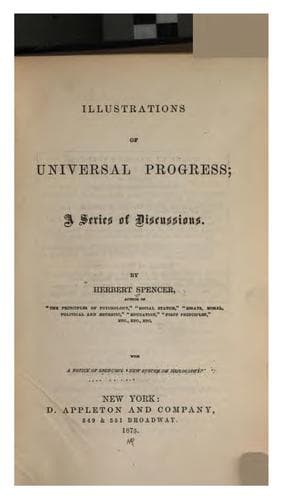
Illustrations of Universal Progress: A Series of DiscussionsSpencer, Herbert
Philosophy
Illustrations of Universal Progress: A Series of Discussions
Spencer, Herbert
Philosophy; Political science; Science
Should he be asked how we are to distinguish between conduct that is
_absolutely_ disagreeable to others, and conduct that is _relatively_ so,
he answers, that they will distinguish themselves, if men will let them.
Actions intrinsically repugnant will ever be frowned upon, and must ever
remain as exceptional as now. Actions not intrinsically repugnant will
establish themselves as proper. No relaxation of customs will introduce the
practice of going to a party in muddy boots, and with unwashed hands; for
the dislike of dirt would continue were Fashion abolished to-morrow. That
love of approbation which now makes people so solicitous to be _en regle_
would still exist--would still make them careful of their personal
appearance--would still induce them to seek admiration by making themselves
ornamental--would still cause them to respect the natural laws of good
behaviour, as they now do the artificial ones. The change would simply be
from a repulsive monotony to a picturesque variety. And if there be any
regulations respecting which it is uncertain whether they are based on
reality or on convention, experiment will soon decide, if due scope be
allowed.
When at length the controversy comes round, as controversies often do, to
the point whence it started, and the "party of order" repeat their charge
against the rebel, that he is sacrificing the feelings of others to the
gratification of his own wilfulness, he replies once for all that they
cheat themselves by mis-statements. He accuses them of being so despotic,
that, not content with being masters over their own ways and habits, they
would be masters over his also; and grumble because he will not let them.
He merely asks the same freedom which they exercise; they, however, propose
to regulate his course as well as their own--to cut and clip his mode of
life into agreement with their approved pattern; and then charge him with
wilfulness and selfishness, because he does not quietly submit! He warns
them that he shall resist, nevertheless; and that he shall do so, not only
for the assertion of his own independence, but for their good. He tells
them that they are slaves, and know it not; that they are shackled, and
kiss their chains; that they have lived all their days in prison, and
complain at the walls being broken down. He says he must persevere,
however, with a view to his own release; and in spite of their present
expostulations, he prophesies that when they have recovered from the fright
which the prospect of freedom produces, they will thank him for aiding in
their emancipation.
Public-domain text, read in full here on John Shaqi.
Reviews
Reviews
No reviews yet
Be the first to share your thoughts on this work.
Elsewhere in the archive
Join the Discussion
Join the discussion
Sign in to leave a comment or review.
Sign InorCreate an account