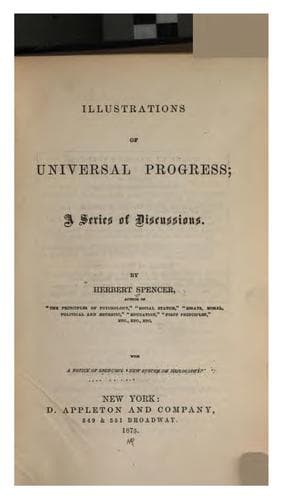
Illustrations of Universal Progress: A Series of DiscussionsSpencer, Herbert
Philosophy
Illustrations of Universal Progress: A Series of Discussions
Spencer, Herbert
Philosophy; Political science; Science
If it be still urged that he is not justified in breaking through others'
forms that he may establish his own, and so sacrificing the wishes of many
to the wishes of one, he replies that all religious and political changes
might be negatived on like grounds. He asks whether Luther's sayings and
doings were not extremely offensive to the mass of his contemporaries;
whether the resistance of Hampden was not disgusting to the time-servers
around him; whether every reformer has not shocked men's prejudices, and
given immense displeasure by the opinions he uttered. The affirmative
answer he follows up by demanding what right the reformer has, then, to
utter these opinions; whether he is not sacrificing the feelings of many to
the feelings of one: and so proves that, to be consistent, his antagonists
must condemn not only all nonconformity in actions, but all nonconformity
in thoughts.
His antagonists rejoin that _his_ position, too, may be pushed to an
absurdity. They argue that if a man may offend by the disregard of some
forms, he may as legitimately do so by the disregard of all; and they
inquire--Why should he not go out to dinner in a dirty shirt, and with an
unshorn chin? Why should he not spit on the drawing-room carpet, and
stretch his heels up to the mantel-shelf?
The convention-breaker answers, that to ask this, implies a confounding of
two widely-different classes of actions--the actions that are _essentially_
displeasurable to those around, with the actions that are but
_incidentally_ displeasurable to them. He whose skin is so unclean as to
offend the nostrils of his neighbours, or he who talks so loudly as to
disturb a whole room, may be justly complained of, and rightly excluded by
society from its assemblies. But he who presents himself in a surtout in
place of a dress-coat, or in brown trousers instead of black, gives offence
not to men's senses, or their innate tastes, but merely to their
prejudices, their bigotry of convention. It cannot be said that his costume
is less elegant or less intrinsically appropriate than the one prescribed;
seeing that a few hours earlier in the day it is admired. It is the implied
rebellion, therefore, that annoys. How little the cause of quarrel has to
do with the dress itself, is seen in the fact that a century ago black
clothes would have been thought preposterous for hours of recreation, and
that a few years hence some now forbidden style may be nearer the
requirements of Fashion than the present one. Thus the reformer explains
that it is not against the natural restraints, but against the artificial
ones, that he protests; and that manifestly the fire of sneers and angry
glances which he has to bear, is poured upon him because he will not bow
down to the idol which society has set up.
Public-domain text, read in full here on John Shaqi.
Reviews
Reviews
No reviews yet
Be the first to share your thoughts on this work.
Elsewhere in the archive
Join the Discussion
Join the discussion
Sign in to leave a comment or review.
Sign InorCreate an account