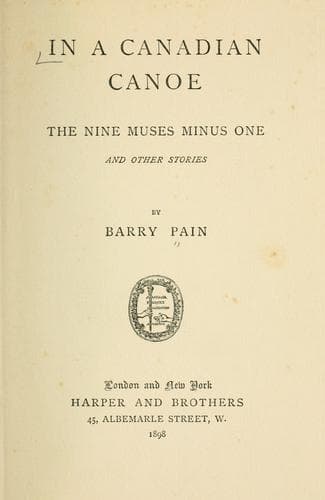
In a Canadian Canoe; The Nine Muses Minus One, and Other StoriesPain, Barry
General
In a Canadian Canoe; The Nine Muses Minus One, and Other Stories
Pain, Barry
English wit and humor
He had dreamed that he was seated on the one side of the fireplace in
his rooms at Cambridge, and that the beetle, with the same exaggerated
dimensions with which Marjorie had seen him, was seated in a lounge
chair on the other side. They were discussing Maurice’s psychological
studies, and Maurice was describing to him some of the curious
experiments which he had made in conjunction with Mr. Meyner. Every
difficulty that Maurice propounded the beetle made clear at once. He
even suggested fresh problems which had not occurred to Maurice before,
and was equally ready with their solution. His last words before
Maurice awoke were: “There are many things besides which you ought to
know, and of which you have not realised your own ignorance. You will
know them all one day.”
This was all that Maurice could remember of his dream. The difficulties
propounded and the explanations given had passed completely out of his
recollection. He was only conscious that during his dream he had felt
an exhilarating sensation of having known for certain things which he
had thought it impossible that any one, at least in this life, could
know at all.
Shortly afterwards he returned to Cambridge. By this time Marjorie
seemed to have recovered her normal spirits. She made no further
allusion to her dream. She was unaffectedly sorry at the departure of
Maurice.
Maurice had not been long at Cambridge before he received news of the
sudden death of Mr. Meyner. Apart from the friendship he had always
felt for Mr. Meyner, the death seemed to him peculiarly distressing and
pathetic. The man had worked hard at a study which fascinated him, not
from any desire for gain, or fame to be derived from it, but with the
most genuine devotion to the study itself; and he had died before his
work was done, before he had arrived at any large and definite result.
Yet Maurice felt assured that Meyner’s patience, and judgment, and
freedom from prejudice, would, if he had but lived longer, have brought
him some reward, some light. He had always distrusted and undervalued
himself; his humility was genuine, but almost irritating. He had been
at school, and subsequently at college, with Maurice’s guardian, and
had first met Maurice when he was a boy of fifteen; the friendship
between the boy and the middle-aged man had formed slowly, but surely,
since then; yet, although he gave every sign of his liking for Maurice,
he never seemed to expect Maurice to like him in return; he certainly
never realised the admiration which Maurice had for his knowledge and
attainments. So too he loved his wife and only child dearly, and he
knew that they loved him; but he had never realised how much they loved
him, and would very possibly have thought such love almost irrational.
To some extent, perhaps, his studies had spoiled him; he had been
groping in the darkness after great things, and the one result that he
seemed to have found there was a sense of his own insignificance. Yet,
Public-domain text, read in full here on John Shaqi.
Reviews
Reviews
No reviews yet
Be the first to share your thoughts on this work.
Elsewhere in the archive
Join the Discussion
Join the discussion
Sign in to leave a comment or review.
Sign InorCreate an account