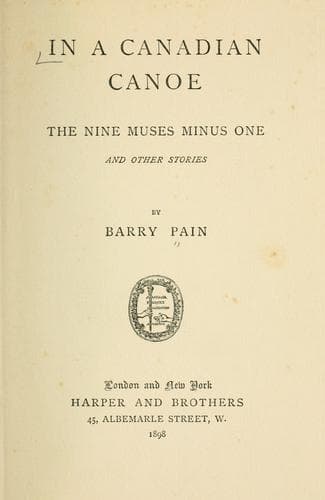
In a Canadian Canoe; The Nine Muses Minus One, and Other StoriesPain, Barry
General
In a Canadian Canoe; The Nine Muses Minus One, and Other Stories
Pain, Barry
English wit and humor
illogically enough, he had never thought others insignificant; he had
never reached the cynical conclusion that nobody matters very much.
If his friends and his sympathies were so few, it was not because the
outside world did not matter to him, but because he could not believe
that he mattered to the outside world. He had died without ever having
learned his own value.
A parcel which was forwarded to Maurice from Mrs. Meyner shortly
afterwards contained the many note-books which her husband had filled
with the evidence he had collected, and the work he had done, until
death interrupted him. With them was a simple and pathetic letter that
he had written to Maurice on the day before he died. “Look through
them,” the letter said, in reference to the note-books. “You will see
and understand what I was aiming at. If you think it worth while, carry
on the investigation which I began; I own that it is some pleasure to
me to think that it is possible that you may do so; that one who was
intimate with my views, and who shared some of my opinions, which are
not generally held, may be able to give those views and opinions their
justification. But I do not want you to pledge yourself in any way, nor
do I ask you to give up your tripos or your career at college for the
purpose.”
Maurice paused as he read this last sentence. How often he had
thought, as he turned English verse into indifferent alcaics, that
this classical work could only lead, was only educative, could never
be considered as an end. But he came to no final decision until he
had spent nearly a month in a rapid survey of those note-books. They
startled him; the minute accuracy and patience shown in the collection
of evidence were only what he expected from such a man as Meyner, but
the brilliant audacity of his theories, the almost savage independence
of an original mind, looked far different when plainly stated in black
and white, than when they had fallen humbly and almost hesitatingly
from the man’s own lips. The romantic side in Maurice’s character was
touched most by what was worst in Meyner’s books; the finished and
unprejudiced scholar would have shaken his head over much that looked
like vain imagining, that was extravagant, and, so far, unsupported.
Maurice was younger; Meyner’s fierce opposition of an accepted view
attracted him, and awoke his pugnacity. He would linger over page
after page of what seemed to him splendid conjecture, of what might
have seemed to others very useless stuff, and say to himself: “If
only one could prove that this _is_ so, instead of longing that it
_may_ be so!” The air of conviction with which Meyner wrote down his
own views on his own subject gained immeasurably in Maurice’s eyes
from the personal knowledge which Maurice had of Meyner’s perpetual
tendency to undervalue himself, and to distrust himself in all other
matters. Even with these views in his mind, he had expected no great
results; he had been too honest to support them with any evidence that
Public-domain text, read in full here on John Shaqi.
Reviews
Reviews
No reviews yet
Be the first to share your thoughts on this work.
Elsewhere in the archive
Join the Discussion
Join the discussion
Sign in to leave a comment or review.
Sign InorCreate an account