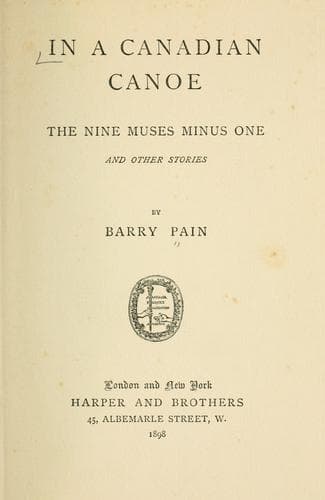
In a Canadian Canoe; The Nine Muses Minus One, and Other StoriesPain, Barry
General
In a Canadian Canoe; The Nine Muses Minus One, and Other Stories
Pain, Barry
English wit and humor
was not thoroughly tested. They seemed to Maurice to be the guess of
genius; the air of conviction had for him the strange attraction of
a religious, not wholly rational, faith. He decided to abandon his
University career, and to devote his time to a further prosecution of
Meyner’s investigations.
His guardian, who was also his uncle, made very little opposition.
Maurice had given so much evidence that he was stable. He had an
unusually large allowance for a young man at Cambridge, and yet he had
not run into debt. At Cambridge the wealthy are the most in debt,
because they have most credit and most temptations. As a matter of
fact, Maurice never had considered the financial side of anything;
it had simply happened that he had never wanted more than he could
well afford. But this weighed very much in Maurice’s favour with his
guardian. He felt that his nephew was a man who understood value, and
could be trusted. The property to which Maurice would succeed, when he
came of age, made it unnecessary for him to adopt any profession; nor
did it bring with it any of those special responsibilities for which a
special training is supposed to be necessary.
Maurice, therefore, spent the next two years abroad, for the most part
in Paris. He had carried with him an introduction to a physician at one
of the Paris hospitals, who sympathised with him in his work, and was
able to be of great assistance to him. In this man he gained a friend;
in other respects these were years, it seemed to him, of disillusion.
One by one the great, beautiful theories had to go; a tiny meagre fact
would start up, a fact that meant but little to the ordinary observer,
and it would be strong enough to overthrow years of work, and send
the conjecture on which they were founded to some limbo for lost
absurdities. He had long ago been aghast when he had tried to realise
how vast is the amount of the things that no man knows. And now for
“knows” he put “can know.”
Mrs. Meyner and Marjorie had also been abroad, but he had seen them
very seldom in those two years. Marjorie seemed to be slowly changing;
he was no longer the recipient of childish confidences. She was grave
and more beautiful, perhaps, than she had been; and she was also more
quiet and reserved; she was friendly with him, up to a limit; she told
him news, of a kind; she sympathised with his disappointments in his
work, within decent bounds. At the end of the second year, when Mrs.
Meyner and Marjorie were staying for a few days in Paris, and Maurice
was at last awakening to the fact that he could not expect childish
confidences from one who was no longer a child, Marjorie told him some
news which surprised him.
“Aunt Julia has changed very much. I like her now.”
“She must certainly have changed then,” said Maurice smiling.
Public-domain text, read in full here on John Shaqi.
Reviews
Reviews
No reviews yet
Be the first to share your thoughts on this work.
Elsewhere in the archive
Join the Discussion
Join the discussion
Sign in to leave a comment or review.
Sign InorCreate an account