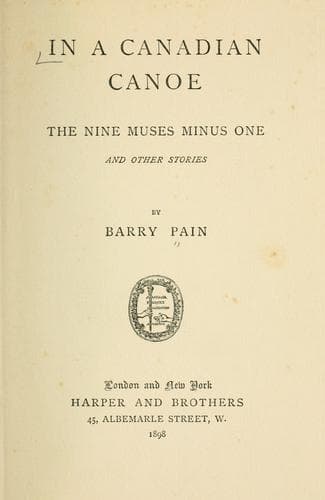
In a Canadian Canoe; The Nine Muses Minus One, and Other StoriesPain, Barry
General
In a Canadian Canoe; The Nine Muses Minus One, and Other Stories
Pain, Barry
English wit and humor
This did not happen at Paris. Maurice had returned to England, and
all of them--Mrs. Meyner, Marjorie, and Maurice--were staying in Aunt
Julia’s house. It was a lonely old house, much too big for that one
wicked old lady; it stood outside a North Yorkshire village, just
where a grand, dignified old hill drew back its skirts, with a sharp
sweep, from contamination with human dwelling-places. Aunt Julia owned
quarries at the foot of the hill, and got therefrom more money than
was good for her. The time was December, and the moors looked bleak
and cold. But it was a comfortable house. Aunt Julia had devoted her
many years to the study of comfort--her own comfort. “There is nothing
to shoot,” she explained to Maurice, “except my tenants down in the
village. You can shoot them, if you like. There’s the library, though,
which is good, and you can smoke anywhere you like----”
“But you used to hate smoking?” said Maurice.
“My dear Maurice, there are two of me, and you used to know the wrong
one. Down in the village they mostly know the wrong one, and they call
her, I am told, the hell-cat, which is rude of them. Yes, you can smoke
anywhere. If you and Marjorie want to go out of the house--which is a
thing I never do in December--I believe there are some horses round
at the back. If there is anything wrong about the horses, or Pilkin,
or anything that is his, just tell me, and I will say a word or two.
I believe the man presumes on my ignorance. You can go and see my
quarries, or my cottages; but you had better not go to the cottages,
because they have no drains. I should like to give them some drains,
but the tenants won’t let me. They are poor people, and a strong smell
makes a difference to their colourless existence.”
So Maurice did a certain amount of reading, riding, and smoking.
But, of course, Marjorie made for him the chief charm of the house.
Mrs. Meyner had willingly consented to the engagement; even if she
had desired to oppose it, her more strenuous half-sister would have
reasoned her out of it; or, to use her own gentle euphemism, would have
said a word or two. The days passed quietly enough. To Maurice they
were a pleasant rest after his three years of wasted laboriousness.
“Marjorie,” he said to her one afternoon, when they had wandered over
the dignified hill, and as they came back saw the bare boughs of the
trees in the plantation black against a red blot of sunset, “Marjorie,
I have done with all questions. I am here, and you are here, and that
is enough for me. I am going to live and love, and enjoy. Blessed be
my fate that has saved me from the sordid worry of life. (Just wait
a second, will you? can’t get a match to light in this wind.) We
will make a beautiful house, with beautiful things in it, with good
books on shelves, and good wine in the cellar, and a good cook in the
kitchen. And no one shall enter into that house who is not either very
beautiful, or very clever, or too good for this world.”
Public-domain text, read in full here on John Shaqi.
Reviews
Reviews
No reviews yet
Be the first to share your thoughts on this work.
Elsewhere in the archive
Join the Discussion
Join the discussion
Sign in to leave a comment or review.
Sign InorCreate an account