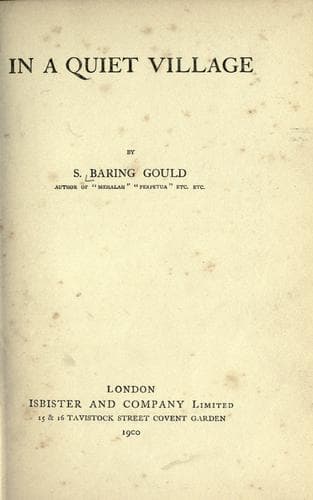
England -- Fiction; Short stories, English; Villages -- Fiction; Wales -- Fiction
So Sela and Tim and the children were admitted into French’s cottage,
and with them moved a great number of cocks and hens, geese and ducks.
Sela was a clever woman with fowls. Indeed, it was through her poultry
that she had maintained herself and children, and had paid the rent. She
sold eggs to the regrater every week, and spring chickens were readily
purchased by the gentry around.
When it was known that the Luppencotts were given a new spell of
occupation in the neighbourhood, that neighbourhood sighed, and said with
one voice, “Well, we _did_ think we were quit of Slouch, but we should
have been sorry to lose Sela.”
Now it might have been supposed that on the roads, cleaning water-tables,
scraping, in winter breaking stones, in autumn spreading them, gave work
that it was not possible for Slouch to fail to execute satisfactorily. In
fact, he was seen for one entire winter engaged on stone heaps, with a
long-handled hammer cracking stones.
But then the heaps knew him no more. He was again out of work. He had
thrown it up in a fit of spleen, because an old man was employed as
well, to save his “coming on the parish,” and this Timothy regarded as
a slight. Added to this, he heard that a new blacksmithery was being
started in an adjoining parish, and, sanguine that he could obtain
occupation there, he threw up his engagement on the roads before he had
secured that at the forge.
And, naturally, he did not get the place on which he had calculated. He
was too well known to be given it. Then ensued the familiar ramble in
quest of employment, but no farmer, no landowner would give him any.
The family would have starved, but for Sela and her poultry. She did not
make much by her fowls, as corn was dear, but they had, and were allowed,
the run of the fields and arishes of John French. Then, also, she got
plenty of skimmed milk from the farm, that was only a halfpenny per
quart, and with milk none can starve. Sela had gleaned at harvest, and
gleaned sufficient wheat to make bread for herself and children.
Mrs. French often saw her—sent for her to assist in cleaning the house,
gave her a spare-rib when she killed a pig—showed her many little
kindnesses. But the old woman had, as she said, no patience with Tim, and
with him would not change a word.
Sela had a cool and clean hand, and was invaluable in butter-making. That
Mrs. French ascertained; so in this new cottage the Slouches got on well,
but no credit attached to Tim for that.
One day Tim was climbing along a rafter of an old outhouse in quest
of eggs, as one of his wife’s hens had stolen a nest, when the rafter
snapped—it was rotten—and down fell Tim on his head, and broke his neck.
He was taken up dead.
The entire neighbourhood at once rushed to one conclusion: “It is just as
well. He never was of any use to any one when alive.”
Public-domain text, read in full here on John Shaqi.
Reviews
Reviews
No reviews yet
Be the first to share your thoughts on this work.
Join the Discussion
Join the discussion
Sign in to leave a comment or review.
Sign InorCreate an account