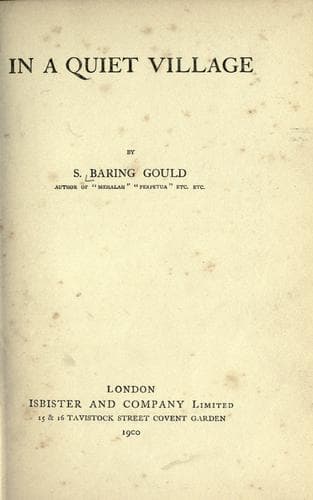
England -- Fiction; Short stories, English; Villages -- Fiction; Wales -- Fiction
“No need of thanks, Tom! Bless my soul, when a master has a trustworthy,
honest servant, it is he is to be counted lucky; and unless he is an ass
he will keep him. There—come round to the study.”
* * * * *
And now nearly two years have passed. And this time we see a little party
coming out of the church porch. As I live! it is Tom with Mary—no longer
Mauduit, but Mountstephen. But they are not alone; there is a baby in a
long white robe being brought forth—a babe that had been carried into
church to be christened.
As Mary stood in the autumn sunlight outside the porch, she touched Tom’s
arm, and said—
“Let us go to little Bessie’s grave.”
And they went, and the baby was taken there also, over the drooping
grass, wet with autumn rains.
“The poor little Christmas tree,” said Mary, “although a Tree of Death,
lives. See—how hearty it appears!”
“It is no Tree of Death,” answered Tom. “See—here is the first fir-cone;
it is alive, and bears seed. It is no Tree of Death, but a Tree of Life.”
Then Tom laughed.
“Mary,” said he, “I think for once in my life I’ve said a good thing.”
But Mary did not applaud.
“Tom, do you think the little fir-cone really has life in it?”
“Of course it has.”
Mary picked it, and then put it into the tiny hand of the baby.
“Look, Tom,” she said. “But for that Christmas tree you and I would never
have become what we are to each other—and now, in it is the seed of life,
and so on and on and on for evermore. Our baby has it, and it shall be
sown, and so—really, Tom, there seems to be no end to life; it goes on
for ever and for ever!”
“Amen,” responded Tom.
FOLK-PRAYERS
FOLK-PRAYERS
It is a singular fact, but fact it is, that very little of what may be
termed peculiarly Romish superstition lingers among the peasantry of
England; this goes far to show how very little hold such superstition
had on their minds or hearts. It may be almost said that there is more
of pre-Christian paganism, of usages condemned by the Catholic Church
surviving, than of any practices recommended by her.
I do know, indeed, of one instance of a Cornish Methodist, who, when
unable to attend his distant chapel, resorted to a rude granite cross of
Brito-Roman date, and there said his prayers; but even in this case one
cannot be certain that there did not linger on a reverence for the stone
itself, which had been a prehistoric menhir before it was sanctified by
being chipped into the sign of our salvation.
Public-domain text, read in full here on John Shaqi.
Reviews
Reviews
No reviews yet
Be the first to share your thoughts on this work.
Elsewhere in the archive
Join the Discussion
Join the discussion
Sign in to leave a comment or review.
Sign InorCreate an account