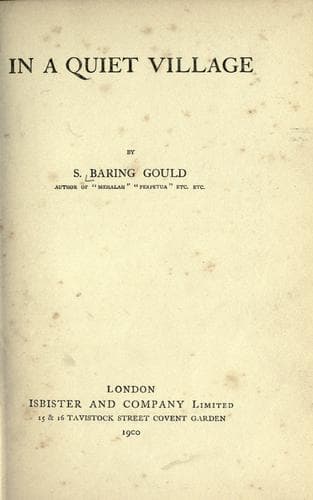
England -- Fiction; Short stories, English; Villages -- Fiction; Wales -- Fiction
In Yorkshire, Milly (my Lady) boxes are carried about by children at
Christmas: these are cradles containing dolls, one to represent the
Virgin Mother, another the Divine Child; and the grocers send candles to
their customers on Christmas Eve, for the lights to be burned at the
Midnight Mass. But such usages are few, and have almost wholly lost their
meaning, were never more than folk customs, and were never inculcated by
the Church before the Reformation. The midsummer bonfires, the Yule log,
the mumming at Christmas, the Maypole, the November “soul-cakes,” the
“sin-eating” at funerals, and a thousand other customs are purely heathen
survivals. The writer knew of a case in Yorkshire of a man who was buried
in his coffin with a candle “to light him on his way to Jerusalem” and
a penny “to pay the toll,” altogether a pagan reminiscence; but has
never in all his experience come across any practice connected with the
doctrine of purgatory, one insisted upon with immense emphasis before
the Reformation, as the saying of masses for the dead brought in a large
revenue for the clergy.
Superstition connected with holy wells is heathen, and was given a
reluctant sanction by the Roman Church, because so deep-rooted that the
people could not be weaned from it.
The custom, so common in the time of our youth, of drinking healths was a
pagan one; the dead were thus saluted silently, and the Bishop of Cork in
1713 charged against it in an address to his diocese. He was answered by
“A Country Curate of Ireland,” and the bishop returned to the charge in a
pamphlet of two hundred and twenty pages.
In Germany, to gloss the heathenism of the custom, it was usual to
drink the first cup to the memory of some saint, usually St. Gertrude,
the patroness of the dead, who had stepped into the place of the Goddess
Holda or Perchta.
But it is chiefly in the prayers used by the illiterate and poor among
the peasantry that we would expect to find some trace of Catholicism,
for the prayer employed in private and secret is precisely where no
interference could affect the convictions and habits formed by ages, and
communicated traditionally at the most impressible age.
Now what do we find actually? That the only prayers used by tens of
thousands, only now very slowly being driven out by the Lord’s Prayer,
or being abandoned because all prayer is given up, are not a Catholic
reminiscence at all, but an heretical one condemned by the Papal Church.
The reader will at once know what the form is to which reference is made.
“Matthew, Mark, Luke, and John,
Bless the bed that I lie on.
Four posties to my bed.
Six angels are outspread,
Two to bottom, two to head,
One to watch me whilst I pray,
One to bear my soul away.”
This is the usual form; but there are verbal variations. Sometimes it
stands “four corners” instead of “four posties,” and “two at the feet,
and two at the head.” After the first two lines that are invariable, we
have—
Public-domain text, read in full here on John Shaqi.
Reviews
Reviews
No reviews yet
Be the first to share your thoughts on this work.
Elsewhere in the archive
Join the Discussion
Join the discussion
Sign in to leave a comment or review.
Sign InorCreate an account