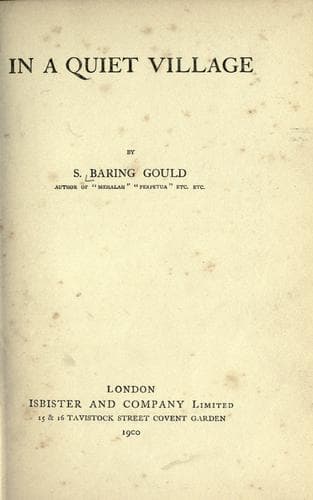
England -- Fiction; Short stories, English; Villages -- Fiction; Wales -- Fiction
Ady, in his “Candle in the Dark, or Treatise concerning the Nature of
Witches and Witchcraft,” Lond., 1656, says, “An old woman in Essex who
was living in my time, she had lived also in Queen Mary’s time, and had
learned thence many popish charms, one whereof was this: every night when
she lay down to sleep she charmed her bed, saying—
‘Matthew, Mark, Luke, and John,
The bed be blest that I lye on.’
And this she would repeat three times, reposing great confidence therein,
because (as she said) she had been taught it when she was a young maid by
the churchmen of those times.”
In a MS. collection of notes on superstitions made by John Aubrey, which
is in the British Museum, Aubrey enters—
“A PRAYER USED WHEN THEY WENT TO BED.
“Matthew, Mark, Luke, and John,
Bless the bed that I lie on,
And blessed guardian angels keep
Me safe from dangers whilst I sleep.”
Aubrey adds, “I remember before the civil wars people when they heard the
clock strike were wont to say, ‘God grant that my last howre may be my
best howre.’”
Robert Chambers, in his “Popular Rhymes of Scotland,” does not speak of
this prayer as used north of the Tweed at bed-time, but says: “A curious
instance of far-descended nonsense is to be found in another puerile
rhyme:—
‘Matthew, Mark, Luke, John,
Haud the horse till I loup on;
Haud it fast, and haud it sure,
Till I get over the misty muir.’
Boys in Scotland say this in the course of their rollicking sports.”
This singular charm, rather than prayer, is given in a mediæval magical
treatise, “The Enchiridion of Pope Leo,” which was printed at Rome in
1660. It is there called “The White Paternoster,” and runs thus in French—
“Petit Patenôtre blanche que Dieu fit, que
Dieu dit, que Dieu mit en Paradis.
Au soir m’allant coucher, je trouves trois
Anges à mon lit couchés, un aux pieds,
Deux au chevet, la bonne Vierge Marie au
Milieu, qui me dit que je me couchis,
Que rien ne doutes.…
Qui la dira trois fois au soir, trois fois au
Matin, gagnera le Paradise à la fin.”
Under the name of “The White Paternoster” it is referred to by Chaucer in
the “Miller’s Tale”—
“Lord Jhesu Crist, and Seynte Benedyht,
Blesse this hous from every wikked wight,
Fro nyghtes verray, the White Paternoster,
Where wonestow now, Seynt Petre’s soster.”
“Nyghtes verray” is probably a night-were, the hobgoblin. “Were” is an
old Saxon word for man, and the night-man is the ghost. In White’s “Way
to the True Church,” Lond., 1624, White complains of “the prodigious
ignorance” which existed among his parishioners when he entered upon his
ministrations. He gives what he considers to be the “White Paternoster,”
or a form of prayer used before going to bed.
Public-domain text, read in full here on John Shaqi.
Reviews
Reviews
No reviews yet
Be the first to share your thoughts on this work.
Elsewhere in the archive
Join the Discussion
Join the discussion
Sign in to leave a comment or review.
Sign InorCreate an account