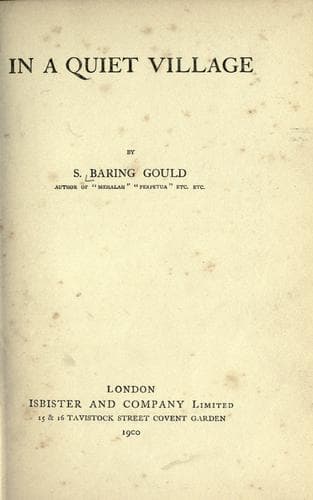
England -- Fiction; Short stories, English; Villages -- Fiction; Wales -- Fiction
“White Paternoster, Saint Peter’s brother,
What hast i the t’one hand? White booke leaves.
What hast i th’ t’other hand? Heaven gate keys.
Open heaven gates, and streike hell gates,
And let every crysan child creepe to its own mother.
White Paternoster. Amen.”
In the first edition of Wynkyn de Worde’s “Horæ Beatæ Mariæ Virginis,”
1502, a copy now in the Gough Library at Oxford has on the margin,
written in a contemporary hand, “The Little Credo,” “The White
Paternoster,” and “The White Benedictus,” another very curious magical
formula. For an account of this see Dibdin’s “Decameron,” second day.
The “White Paternoster” is as generally in use among the peasants in
France as in England. It takes various forms. In Quercy, part of our
English possessions in Guyenne, it is recited nightly under another name,
the “Pater d’habitude.” The patois may be thus translated:—
“Pater d’habitude,
Our Saviour salute us;
He is at our head, he is at our feet,
He is now and he is after,
He is in the bed where I lie.
Five angels there I find,
Three at bottom, two at head,
And the mother of God in the midst.
She bids me sleep so sound,
Never fear, nor flames, nor fire,
Nor sudden death at all.
I take our Saviour as my father,
The Virgin Mary as my mother,
Saint John for my cousin,
Saint Michael for my sponsor.
There are god parents four.
Whatever haps, whatever befalls,
I shall go to Paradise.”
There are, in fact, in Guyenne four Paternosters—the great one, the small
one, the Pater of Nazareth, and the Pater of Habit; and these make up one
complete formula. M. Daymard, who has collected the folk-songs of Quercy,
the present Department of Lot, says, “Who has not heard some old woman
mutter her prayers in a monotonous voice, without accent, with, however,
a sort of rhythmic cadence, like the reading of poetry by children
in school?” If in the course of her prayers she be interrupted and
questioned relative to what she has said, and asked to repeat it, it is
rarely that one can be found to continue her prayers without recommencing
the recitation.
“Very often the old women do not understand what they say. They repeat
words which anciently were in Latin, Romance, or French, and which,
passing from mouth to mouth, have become corrupted till they cease to be
comprehensible. Then they have not, as an assistance to their memory, the
help of an air and of couplets; consequently they slide away into the
greatest confusion. Thus it falls out that the majority of these prayers
are long, disconnected, made up of patches ill-stitched together, and
without affinity, without transition. There are also set phrases and
elements of prayer which recur, and which each pious soul throws into her
common prayers without rhyme or reason.”
Public-domain text, read in full here on John Shaqi.
Reviews
Reviews
No reviews yet
Be the first to share your thoughts on this work.
Elsewhere in the archive
Join the Discussion
Join the discussion
Sign in to leave a comment or review.
Sign InorCreate an account