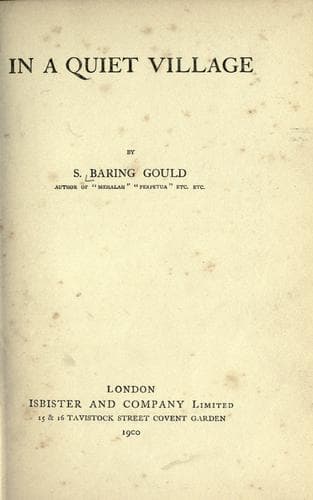
England -- Fiction; Short stories, English; Villages -- Fiction; Wales -- Fiction
Now mark a wonderful provision of nature. All the rain that falls along
the range of chalk hills sinks in, soaks down, and might sink away
to—goodness knows where, but that, beneath the chalk lies a bed of very
dense clay, through which the water cannot descend, and between the chalk
and the clay is strewn a narrow film of gravel, called the greensand,
there hardly thicker than your hand. When the water has percolated
through the chalk hills and is stopped by the clay, out it runs, on the
inland scarp, through the greensand, in a thousand crystal-cool and
beautiful springs, thoroughly purified by this perfect natural filter.
On the inland flank of the South Downs, in a little coomb or valley
scooped out of the chalk, gushed nine of these springs and fed a tarn
or lake, not natural, but formed by an embankment thrown up to form a
reservoir for a mill. Above this lake set in the lap of the Downs were
clumps of Scotch pines, and a wood of beech, in spring full of the purple
and the white scented wood orchis; on the Downs about grew the quaintly
beautiful bee-orchis, rare elsewhere save on chalk.
In a solitary cottage under the hill, in a shady spot where the sun
rarely came, lived a widow and her daughter. The widow was very infirm,
crippled with rheumatism, and was allowed eighteenpence a week and a
loaf by the parish. She was too weak and helpless to earn anything
for herself, and she could not have subsisted, she and her child,
on eighteenpence and one loaf, had it not been for certain means of
acquiring money that the neighbourhood afforded. The South Down chalk
hills abound in hedgehogs. They are to be found in burrows in great
numbers, and at evening, when the dew is falling, the side of the down
may be seen alive with these little creatures scampering about seeking
their prey. The widow’s girl, Jane, a young girl uncouth in form, with
low brow and dull unintelligent eyes, was clever in finding hedgehogs,
and these she carried about coiled up in a basket, and sold them to
people who were troubled with slugs and snails in their gardens, or with
cockroaches and black-beetles in their kitchens. She got a shilling
for each hedgehog, and could, had the demand required it, have found a
hedgehog _per diem_, which would have brought her in 365 shillings in
the year, or £18, 5s. 0d.—a handsome income. But, unfortunately, the
public were not athirst for hedgehogs; and the market was soon glutted.
Consequently Jane had to seek other means of earning money. She found
dormice in the woods, and as there were two large schools for boys,
Hurstpierpoint and Lancing, within a walk, and in schools for boys the
passion for the acquisition of dormice is insatiable, “Crazy Jane,” as
the dull-witted girl was called, found that she could sell at 4d. each
as many dormice as she could find. But then the dormice were only to be
caught when hybernating. In summer they were too wide-awake to allow
themselves to be captured.
Public-domain text, read in full here on John Shaqi.
Reviews
Reviews
No reviews yet
Be the first to share your thoughts on this work.
Elsewhere in the archive
Join the Discussion
Join the discussion
Sign in to leave a comment or review.
Sign InorCreate an account