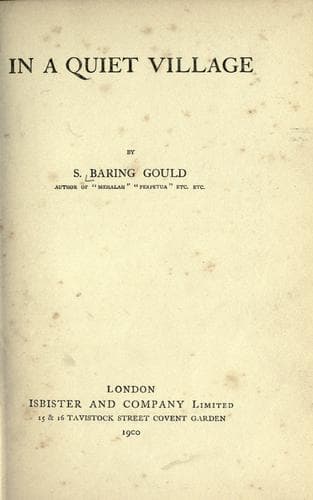
England -- Fiction; Short stories, English; Villages -- Fiction; Wales -- Fiction
In Sussex a great bank of chalk downs stands up as if set as a natural
sea-wall against the encroachments of the waves. Nothing can be conceived
more barren, more dreary than this bank on its seaward slope. On the
east coast of England, in Essex, in Lincoln, in Suffolk and Norfolk,
the energy of man has reclaimed tracts of low-lying land from the sea,
and has held back the tide by erecting sea-walls that have a long
gradually-declining escarpment towards the water. Against these the waves
fling themselves, are broken, run up them, lose their force, and sneak
back discomfited. On the land side these walls have an abrupt fall. Now
the south coast of Sussex seems by nature to have been thus constructed
as a great type after which men should build and recover land. About
three or four miles inland—perhaps a little more—begins what is called
the Weald, a flat, rich, and beautiful land, well wooded, full of sweet
villages and gentle pastures, with here and there an undulation, like a
fold in green velvet, and here and there a pond occupying a deserted iron
quarry. From this Wealden district rises to the south the abrupt scar of
the South Downs, a mighty rampart of chalk, tilted up with its long easy
slope seawards.
Did that mighty primeval ocean rage against the coast where now stand
Brighton, Worthing, and Shoreham? Did that great natural sea-wall of
chalk restrain its waves and protect the Weald from inundation? We cannot
say.
At one point in the summit of the chalk barrier is a trench cut deep
through the soft white rock, and this is called the Devil’s Dyke. The
story told of it is that the enemy of mankind, looking down on the
fertile Weald, envied its beauty and richness, and set to work one night
to dig through the barrier, so as to let the ocean in, to submerge the
fair district. But he could do this only in one night. His power to work
evil was limited. If he could make his canal before cock-crow, well; but
he might on no account resume the work if left incomplete in one night.
Now there was a cottage on the height, and in it lived an old Goodie,
who was roused by the sound of digging and delving in the night. The
night was dark, dark as Erebus; she opened her casement and peeped forth.
Nothing was visible, but the earth quaked under the efforts made by
Mephistopheles. Then the Goodie, being an old fool, lit a candle, held it
outside the window and screamed out, “Who’s there? What are you a-doing?”
Now a cock saw the candle, and thinking it was the first glimmer of dawn,
began to crow. Then the evil one threw away his spade and fled in a rage.
And, lo! there in the dyke, is shown the half-finished work and the
unejected shovelful of earth.
Such is the legend. In reality, no doubt, the dyke is a very ancient
aboriginal fortification.
Public-domain text, read in full here on John Shaqi.
Reviews
Reviews
No reviews yet
Be the first to share your thoughts on this work.
Elsewhere in the archive
Join the Discussion
Join the discussion
Sign in to leave a comment or review.
Sign InorCreate an account