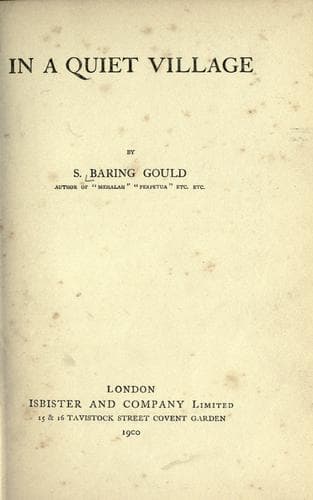
England -- Fiction; Short stories, English; Villages -- Fiction; Wales -- Fiction
And to this he lent himself. He had not sought it. It was forced upon
him. It might do good, he argued; it could do no harm. So his fame grew,
and he was regarded with reverential awe. Whether he believed in his own
efficacy as a healer, I cannot say; his gifts of healing were bruited
about, his failures passed into the limbo of oblivion. He did not set
store on his reputed powers, he rather disparaged them, or shrugged his
shoulders and professed scepticism over them, and he always said: “Well,
if good comes of it, it is not from me—you must know that—but from the
great Healer of all. Some cures wi’ drugs, and some wi’ their touch.
There are differences of administration.”
Dan’l Coombe was a regular churchgoer.
Woe betide the parson if, in preaching without a book, he quoted
Scripture inaccurately. He became in time accustomed to find the tailor
standing at the foot of the church steps awaiting him after service. Then
would come the familiar touch of the hat, and, “I beg your pardon, sir,
but did you not put in a _the_ where there oughtn’t to be, in that there
text from St. Paul to the Corinthians?”
Or else: “Please, sir, did you use the right word in that there quotation
from the Acts?”
“Dear Mr. Coombe, I took the marginal rendering.”
“Oh, the margin. I don’t hold by that.”
Mr. Coombe was very much perplexed when the new version of the Scriptures
was issued. It happily was not read in the parish church. I verily
believe it would have driven him from it. “Nasty, lumpy thing,” he said;
“it is like eatin’ bad-made porridge. Nothin’ smooth about it. Bits come
in your mouth and teeth at every moment.”
He resented it as an immoral thing. “And to think,” said he, “that
Christian money should ha’ been spent by Government out of our pockets
to put this here stumbling-block in the way of the blind! It’s wicked,
and I’ll vote against Government next ’lection.”
As already said, there had been an attempt made by scaling to peer in
at the holes in Coombe’s shutter, to see him at his nightly occupation.
It had failed. After that he pasted two pieces of oiled paper over the
openings, and thus prevented any further observations being made.
So time went on, and his neighbours became accustomed to the two yellow
eyes, and no longer actively concerned themselves about his doings,
though still a good deal of puzzlement remained about his nightly doings.
“To my knowing,” said Mrs. Bacon to Mrs. Jones, “he had his lamp burning
till half-past ten at night. Now he don’t burn a lamp all that time for
the sake of wasting oil.”
“I’ll tell you something more,” said Mrs. Jones; “it isn’t oil only as he
consumes, it is ink as well. He has bought ten penny ink-pots, and one
wi’ red ink, at Miss Buck’s shop in a twelvemonth. What do he want wi’ so
much ink? He can’t drink it.”
“He is writing a book. Take my word for it.”
“A book! What about? He don’t know nothing.”
“Poetry, perhaps. A man may write that with his head empty. Every fool
knows that.”
Public-domain text, read in full here on John Shaqi.
Reviews
Reviews
No reviews yet
Be the first to share your thoughts on this work.
Join the Discussion
Join the discussion
Sign in to leave a comment or review.
Sign InorCreate an account