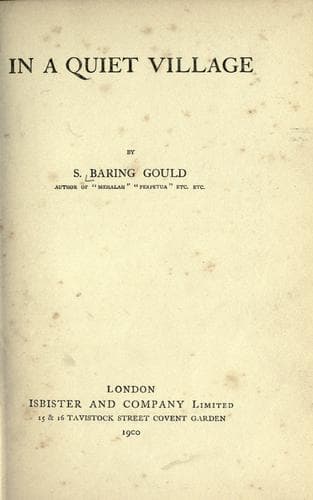
England -- Fiction; Short stories, English; Villages -- Fiction; Wales -- Fiction
Of his son he professed to know nothing. He had not run across him in his
meanders through the shady world in which he had moved. But in the heart
of Auntie there was still a root of love and expectation that concerned
John.
Above Mr. Warnacre’s grave, Auntie, by stinting herself, was able to
erect a costly monumental stone, on which was represented a broken lily,
the symbol of Warnacre’s stainless life. The inscription recorded his
merits in somewhat fulsome terms that were, however, not unreal and
untrue to Auntie, or she would not have sanctioned them, for over that
wretched creature still hung some of the halo of her first love and
idealisation.
And after that her sight failed, and happily not long after that,
gently, without pain, old Auntie’s eyes closed altogether.
But then Mrs. Estcourt was gone. Her husband had predeceased her, and at
the Hall reigned a nephew, a man of sport, who knew not Auntie.
A year later there appeared a stranger in the place, who after some
inquiries went to the churchyard and asked the sexton to point out to him
where Auntie was buried. There was no headstone, only a green mound. But
there were flowers strewn on it; the poor whom she had loved and to whom
she had ministered had not forgotten her.
The stranger signed to the sexton to leave him. Then he stood, with
folded hands and bowed head, looking at the little heap. He was a young
man, but with a seamed face. Presently the tears came into his eyes
and rolled down his cheeks. “Poor, dear Auntie,” he said in a whisper,
“imposed on, ill-treated—only appreciated by me—and that too late.”
He drew out of his pocket a little cross made of perforated cardboard. It
had been given years before to young John.
Then he went to a monumental stone-cutter and said: “Make me a marble
cross, just like this.”
“And, sir, what shall I cut on it?”
“Only this—AUNTIE.”
BROTHER AUGUSTINE
BROTHER AUGUSTINE
In 1866 I was appointed to the perpetual curacy of Dalton, near Thirsk
in Yorkshire. It was a new parish, cut out of Topcliffe; the church
was not built at the time, but an old barn had been converted into a
school-chapel, and a little red brick house had been erected, intended
eventually to be a schoolmaster’s house, which I was given as parsonage.
It was small—containing one sitting-room only, and three bedrooms
upstairs. When I went to see the place, the outgoing incumbent said to
me, “Would you like to take on Mills?”
“Mills! Who is Mills?”
“I mean Brother Augustine.”
“Brother Augustine!” I echoed; “and who the dickens is Brother Augustine?”
“Well,” replied my friend, “that is not so easy to answer. What he is now
is my valet and sacristan. He is a man who can make your clothes, mend
anything, wait on you, and be most serviceable in church.”
“What! that fellow who sang in the choir through his nose as though there
had been a vibrating metallic tongue in it?”
“The same: very useful, but odd.”
“Where did you pick him up?”
“I advertised for him.”
Public-domain text, read in full here on John Shaqi.
Reviews
Reviews
No reviews yet
Be the first to share your thoughts on this work.
Join the Discussion
Join the discussion
Sign in to leave a comment or review.
Sign InorCreate an account