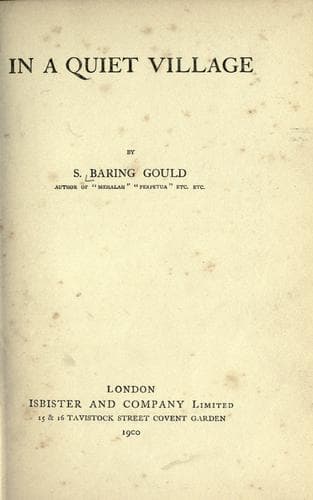
England -- Fiction; Short stories, English; Villages -- Fiction; Wales -- Fiction
When I was in France a few years ago, in a town church in the south, I
heard an abbé once preach on marriage, and contrast its indissolubility
in Catholic France with the laxity in Protestant England, where “any
one, when tired of his wife, puts a halter round her neck, takes her to
the next market town and sells her for what she will fetch.” I ventured
to call on this abbé and remonstrate, but he answered me he had seen
the fact stated in books of the highest authority, and that my disputing
the statement did not prove that his authorities were wrong, but that my
experience was limited, and he asked me point-blank whether I had never
known such cases. There, unhappily, he had me on the hip. And when I was
obliged to confess that I _did_ know of one such case, “Mais, voilà, mon
Dieu,” said he, and shrugged his shoulders with a triumphant smile.
Now it must be allowed that such sales have taken place, and that this is
so is due to rooted conviction in the rustic mind that such a transaction
is legal and morally permissible.
The case I knew was this.
There lived a tall, thin man in the parish when I was a boy, who was the
village poet. Whenever an event of any consequence took place within the
confines of the parish, such as the marriage of the squire’s daughter,
he came down to the manor-house with a copy of verses he had composed on
the occasion, and was then given his dinner and a crown. Now this man had
actually bought his wife for half-a-crown. Her husband had led her into
Okehampton and had sold her there in the market. The poet purchased her
for half the sum he had received for one of his poems, and led her home
with him, a distance of twelve miles, by the halter, he holding it in his
hand, she placidly, contentedly, wearing the loop about her neck.
The report that Henry Frost was leading home his half-crown wife preceded
the arrival of the couple, and when they entered the village all the
inhabitants turned out to see the spectacle.
Now this arrangement was not very satisfactory to either squire or
rector, and both intervened. Henry Frost maintained that Anne was his
legitimate wife, for “he had not only bought her in the market, but had
led her home, with the halter in his hand, and he’d take his Bible oath
that he never took the halter off her till she had crossed his doorstep
and he had shut the door.”
The parson took down the Bible, the squire “Burn’s Justice of Peace,”
and strove to convince Harry that his conduct was warranted by neither
Scripture nor the law of the land. “I don’t care,” he said, “her’s my
wife, as sure as if we was spliced at the altar, for and because I paid
half-a-crown, and I never took off the halter till her was in my house;
lor’ bless yer honours, you may ask any one if that ain’t marriage, good,
sound, and Christian, and every one will tell you it is.”
Mr. Henry Frost lived in a cottage that was on lives, so the squire was
unable to bring compulsion to bear on him.
Public-domain text, read in full here on John Shaqi.
Reviews
Reviews
No reviews yet
Be the first to share your thoughts on this work.
Join the Discussion
Join the discussion
Sign in to leave a comment or review.
Sign InorCreate an account