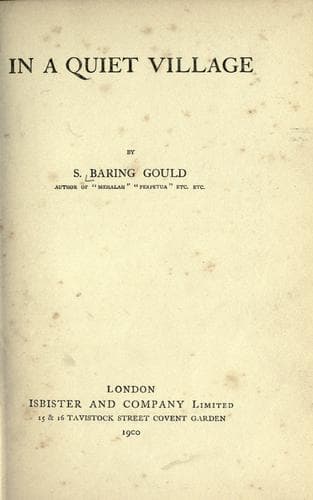
England -- Fiction; Short stories, English; Villages -- Fiction; Wales -- Fiction
The day of the funeral arrived. Little Rosie was placed in her coffin of
plain deal. She had been so small, had become so light through sickness,
that the coffin was no weight to speak of. The poor mother was without
means, the father was nowhere to be found; he was in no club—that is to
say, in no benefit club. He was a member of three political clubs, that
brought in no benefit at all, but entailed payments. The funeral must be
carried out in the most economical manner. Of neighbours there were only
the inmates of Woodman’s Well. Owing to the insulated position of this
cluster, the population of the circumfluent parish of Walmoden did not
regard itself as responsible for sympathy. At a child’s funeral it was
not etiquette for ardent spirits to be provided; consequently the funeral
arrangements were of the most meagre description, and the number of
sympathisers few. Jack was to tuck the little coffin under his arm and
carry it to Sugden churchyard, and of mourners there would be but Mrs.
Weldon and Kate Westlake. The old witch undertook during their absence to
keep company with the bereaved mother, who had not the strength to follow
the corpse three miles to its last resting-place.
On the way another woman would fall in, who lived in an old octagonal,
abandoned toll-gate, and had a passion for funerals, and went to every
interment, whoever it might be that was buried, an acquaintance or a
stranger.
The day was lovely. Wood-doves cooed in the coppice, and blackbirds
fluted; in the blue sky compact white clouds drifted like icebergs in
a still ocean. Jack Weldon had done his best to assume a mourner’s
appearance: he had put on a black round cap with crape about it, a black
coat, but could not muster other than brown continuations. His mother had
hunted up his father’s Sunday pair; but his father had been a short and
stout man. These would not fit the length of Jack’s legs, and about the
waist would have been double, like a Jaeger jersey.
“We must do what we can,” said the widow; “nobody expects us to do more.
I’ll stitch a black crape band round the leg above the knee. Gentlefolks
does it on the arm.”
By this method the snuff-coloured continuations of Jack were given a
suitably lugubrious expression. If they were not black, they tried to
look funereal.
“After all,” said Mrs. Weldon, “you don’t expect for babies what you do
for grown-ups.”
So the procession started, and augmented itself on the way by the
contingent from the toll-gate.
The woman from the latter was of an age agreeable with that of Mrs.
Weldon. The way was long. It comported with the occasion to move slowly.
That two old women, both naturally prone to gossip, should walk all the
way in silence, was not to be expected; and they were soon in full flow
of conversation, carried on in an undertone.
But if it was impossible for two old women to walk three miles in
silence, so was it impossible for two young people to do so.
Public-domain text, read in full here on John Shaqi.
Reviews
Reviews
No reviews yet
Be the first to share your thoughts on this work.
Elsewhere in the archive
Join the Discussion
Join the discussion
Sign in to leave a comment or review.
Sign InorCreate an account