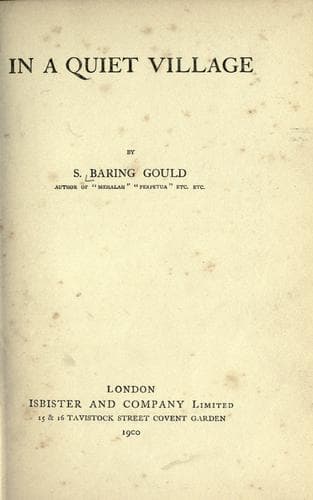
England -- Fiction; Short stories, English; Villages -- Fiction; Wales -- Fiction
Jack ought to have led the way, followed by Kate; but Jack was burdened,
and lagged accordingly, and Kate had an impulsive spirit, and therefore
forged ahead.
“I say, Jack,” said Kate, “be Rosie terrible heavy?”
“Weighs no more than a feather,” answered he. “Poor mite, she wasted away
to nothing at all.”
“I asked because I thought you seemed tired.”
“I tired?”
“Well, you look hot.”
“Hot I be—it is the weather. I’m perspiring wonderful, and can’t get at
my pocket-handkerchief—it is in the pocket next the coffin.”
“If you don’t mind, I’ll wipe your face,” said the girl. “But you must
stand still and stoop.”
Jack halted, bowed, and Kate passed her white cambric pocket-handkerchief
over his face.
“Thank y’,” said the bearer. “It’s terrible refreshing, and smells
beautiful.”
“That’s scent I put on it,” explained the girl.
Meanwhile the old women were in lively converse. The black strip round
Jack’s leg had started them; they diverged to the scandal of Thomas
Leveridge being away when his child died, and not being present at the
funeral.
“I’ll tell you what it is,” said Mrs. Weldon, “men are monsters. They’ve
no more feelings than have traction engines. I wish we could get along
without them.”
“But Jack?”
“Ah! Jack is a good son. I’m not speaking of lads, but of married men.
There is poor Mrs. Leveridge, left without a shilling; and whatever she
would have done had not Jack caught her a rabbit, I do not know. It all
comes of politics.”
“You’re right there,” said the woman from the toll-gate; “when they get
politics into their heads, it’s worse than beer. They can get the better
of liquor with a good sleep, but of politics”—she shook her head and
sighed. “I’ll tell y’ what it is,” continued Mrs. Weldon. “It’s our own
faults that the men get that rampageous. We give in to them too much. My
husband never went after ale or politics; but then I taught him his duty
from the beginning.”
“That’s it—it all comes of beginning well,” said the toll-gate mourner.
“It’s the same with dogs and with poultry. Lor’ bless you, if I didn’t
take the stick to my cochin-china, he’d be all over the kitchen.”
“I’d never advise any girl to marry,” said Mrs. Weldon.
“Nor I neither,” was the reply; “it’s a pity they won’t take advice—they
are that wilful.”
Both couples were interrupted in their respective conversations by a
rattle of wheels, shouts, a waving of colours, and up came a light
cart occupied by a couple of men, one driving, both vociferating, one
brandishing a whip, the other waving a parti-coloured sheet attached to
a stick. The cart was drawn by a donkey with coloured rosettes, and was
urged forward by the whip, at the end of which was a favour, accentuated
with a bunch of thorns. The donkey, stung by the thorns, frightened by
the yells, was galloping, and the banner was streaming in the air.
Public-domain text, read in full here on John Shaqi.
Reviews
Reviews
No reviews yet
Be the first to share your thoughts on this work.
Elsewhere in the archive
Join the Discussion
Join the discussion
Sign in to leave a comment or review.
Sign InorCreate an account