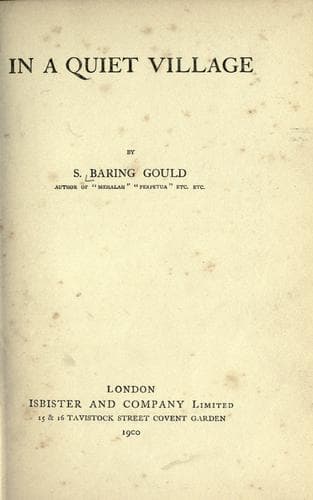
England -- Fiction; Short stories, English; Villages -- Fiction; Wales -- Fiction
“Really,” said the rector’s wife, “it is a satisfaction to give Sela any
of the children’s old garments. She is wonderful with her needle. I did
feel almost ashamed to let her have little Mary’s old school-dress, it
was so frayed, so spotted, and so untidy. And will you believe it—her
child was at church on Sunday in that identical gown! She had turned it,
and contrived it in such a manner, that I could hardly believe my eyes.
That is a woman to help, because every little help is put out to usury.
But Timothy; oh, what a man he is!”
One Sunday, after service, the Squire awaited the rector as he left the
church.
No sooner had the latter descended the avenue and the churchyard
steps, than the Squire—without any other salutation than, “I say! I
say!”—plunged into the matter that occupied his mind, and of which he
desired to disburden himself.
“Rector, that Timothy Slouch.”
“Well, Squire?”
“I say—I say, you know that I set him the rhododendrons to pin down.”
“I know it.”
“Will you believe me—he has made a mess of the job.”
“I can believe a good deal of Slouch.”
“He has actually split them so as to get the refractory branches
down, and where he has pegged, and not torn asunder, has done it so
inefficiently that when his work is effected, in twenty-five minutes they
have slipped their pegs out, and are erect as before.”
“How tiresome!”
“Yes, and he has half-ruined some of my choicest and most expensive
varieties. He has riven and wrenched them about and knocked off the
flowering buds. I was so angry I dismissed him. Not another day’s work
shall he have from me. I am sorry—for Sela’s sake. But it cannot be
helped.”
For three weeks Tim lounged about, said he was looking for work; but if
he did, looked for it in the wrong quarters. Then he appeared before the
rector—not of his own parish, but the parson whose wife had befriended
Sela, and said that he had heard of work in South Wales. He had a cousin
there who was in a colliery, and who wrote that there was always a place
for a handy man, and above all for a blacksmith.
“Well,” said the rector hesitatingly—he saw what Tim was aiming at—“but
exactly, are you the handy man?”
“I can turn my hand to anything. I have been in so many different
situations. I have been blacksmith, and I have done farm-work, and
recently, I may say, I have been a gardener.”
“I daresay you can turn your hand to anything, but can you keep it where
turned?”
“One can but try. Luck so far has been against me. My notion is, sir, if
you would draw me up a brief, I will try to collect money to take me to
Wales, and when there and have got a situation, I will send for my wife
and children to live there with me; one must first have a nest into which
to put one’s doves.”
“Quite so. Well, we will give you one chance more.”
So the rector drew out a brief. It was cautiously worded; it contained a
statement in accordance with Timothy’s representations.
Public-domain text, read in full here on John Shaqi.
Reviews
Reviews
No reviews yet
Be the first to share your thoughts on this work.
Join the Discussion
Join the discussion
Sign in to leave a comment or review.
Sign InorCreate an account