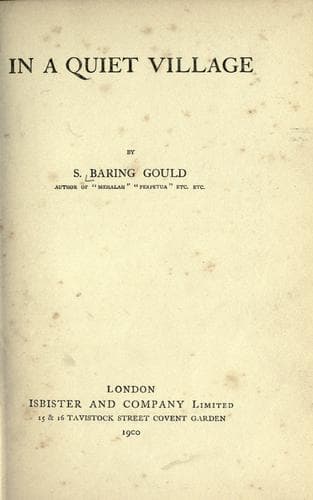
England -- Fiction; Short stories, English; Villages -- Fiction; Wales -- Fiction
We had, when I was about thirteen, a maid of the name of Cicely Crowe;
she was an excellent servant, with a passionate love of neatness, did her
work well and conscientiously, but had not the most amiable disposition
or the most gracious manner. She was not a bad-tempered woman, never
violent, but, just as a diamond is said to be off colour if the least
lacking in absolute clearness, so may she be said to have been off
temper. She was very kind-hearted, but it seemed to go against her pride
to do a kind thing in a kind way. She never saw the good in anything,
only the faults. We all liked Cicely, but we all wished she would try to
be more pleasing. However, we have each our blurs in this world, one in
one way, one in another, and had Cicely’s mood been sunny, and her manner
sparkling, why she would have been snapped up at once, and half the young
men in the village would have been quarrelling as to who should have her.
It was just this uncertainty in her temper which deterred them, and kept
her in our service so many years.
She was a very pretty girl, was Cicely, with brown hair, so neat that
never was a hair out of place, and with large hazel eyes, and such a
complexion!—cream and strawberry were nothing to it, and the colour
palpitated under her transparent skin like the flush of the evening sun
on far-off delicate clouds.
The lads of the village said to each other, “What a lass that Cicely is,
but—” And our friends said to my mother, “What a very nice, respectable
servant girl you have in Cicely.” “Oh dear, yes,” answered my mother,
“she is everything that could be desired, but—” And her fellow-servants
all said, “We have nothing to say against Cicely, but—” And we children
remarked to each other, “Cicely is tremendously nice, but—” No one ever
got any further than “but—,” for no one could bring it over the lips to
say a word in depreciation of Cicely.
Now it fell out all on a summer’s day that cook had gone off for a
holiday, and the kitchen-maid had sickened with measles and been sent
home, and with great trepidation, and with a tremulous voice, and an
appeal in her eyes, my mother had asked Cicely if she _would_, under the
circumstances, boil the potatoes and the greens for the early dinner on
that Sunday. There was nothing to roast, nothing to stew; cook had made
cold pies and shapes, and so on, to last till her return.
Cicely replied ungraciously that everything was put on her, but she
supposed she must do it, and then turned her back on my mother and went
off to change her gown. As I have said, it was Sunday. I had a sore
throat, and so was not allowed to go to church, and was bidden remain at
home, not go outside the doors, and keep myself warm.
Public-domain text, read in full here on John Shaqi.
Reviews
Reviews
No reviews yet
Be the first to share your thoughts on this work.
Elsewhere in the archive
Join the Discussion
Join the discussion
Sign in to leave a comment or review.
Sign InorCreate an account