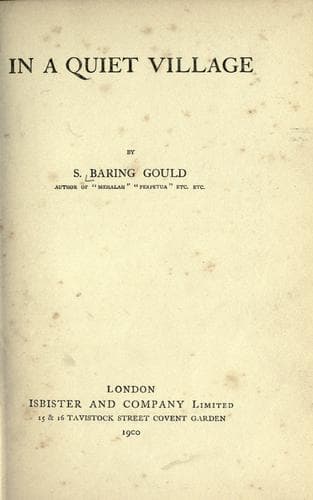
England -- Fiction; Short stories, English; Villages -- Fiction; Wales -- Fiction
Now I had calculated on this, and had borrowed a rat-trap from the
gardener, and when Cicely was upstairs putting on such garments as she
deemed suitable for peeling potatoes and shelling peas, and cooking them,
I slipped up the stairs into the garret, hugging the trap, and holding a
piece of cheese-rind I had surreptitiously seized on and had roasted over
my candle. I was resolved on spending the time whilst my parents were
at church in catching a rat. There was a loose slate in the roof and I
tilted this up, peeped out, and watched my father and mother, brothers
and sisters, and the governess stalk away from the front door in their
Sunday suits, with prayer-books under their arms, and I saw my dear
mother pick off sundry bits of “fluff,” ends of thread, &c., which her
eye detected on the children’s clothes.
Then I heard a bustle of feet underneath, and some tongues, and I knew
that the domestics were also off to church by the back door. Thereupon I
set my trap, and sat down behind a barrel in the corner waiting to hear
the rats come out, and to watch them snuff at, then bite the bait, and,
snap—be caught.
Whilst I waited, and, waiting, learned my collect which had been set me
as a task, I heard Cicely come into the back kitchen, and with a sharp
motion pull the pan to her in which were the potatoes she had to peel.
Almost immediately after I heard the kitchen door open, and a male voice
exclaim, “Well, Cicely, so here you are?”
“I s’pose I be,” was her answer.
Now the floor of the loft was of boards, and in these boards were knots,
and the centre of some of these had fallen out. The back kitchen was not
ceiled. One of these peep-holes was close to me, so very gently I lay
down flat on the floor and applied my eye to the hole, and then saw that
a young man had entered named Will Swan.
I knew him well. He had a boat, and was a fisherman; an honest, cheerful
fellow, with whom I often went out on the sea. He was uncommonly civil,
and would insist on carrying the fish I caught, or fancied I had caught,
home for me.
Now only did it dawn on my infantile mind that his carrying the fish was
due not so much to a wish to oblige me, as to have an excuse for coming
into our kitchen to see Cicely Crowe.
“What’s brought you here?” asked Cicely.
“I wanted to see you and have a bit of a talk.”
“I’m busy,” was her curt answer.
“Ciss, I want a good-bye before I go.”
“Well, the door is open—Good-bye.”
He halted at the entrance, hesitated a while, and then said: “You will be
pleased to hear, Ciss, that the good-bye I asked for is one for ever.”
She dropped the potato she was peeling, but did not look at him; she took
up the potato again.
“I’m thinking of leaving—going to America.”
She did not answer for a while, but as he waited for an observation, she
said, “Indeed. Hope you’ll enjoy yourself there.”
“I am not going there to enjoy myself, but because—well, Ciss—I can’t
feel any joy here in the old country.”
“You seem merry enough.”
Public-domain text, read in full here on John Shaqi.
Reviews
Reviews
No reviews yet
Be the first to share your thoughts on this work.
Elsewhere in the archive
Join the Discussion
Join the discussion
Sign in to leave a comment or review.
Sign InorCreate an account