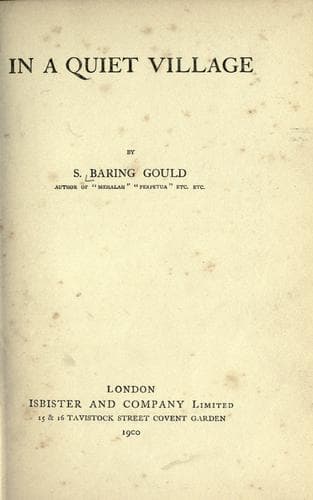
England -- Fiction; Short stories, English; Villages -- Fiction; Wales -- Fiction
She heard talk of him too. He was much at the Ship Inn; and Kate Varcoe,
the daughter of the host, was a “likely lass,” cheerful, fresh-faced,
with black dancing eyes. With Kate he chaffed and made merry. Cicely
listened every Sunday to hear the banns called, but no—called they were
not. Next, some one said that William had a sweetheart in Bristol.
Oh, in Bristol! Then why should not she show him that if he could be
false she would be so also. For a while she allowed herself to be walked
out by young Hannaway, a respectable youth, a carpenter by trade, who
made the coffins for all the neighbourhood, and undertook in black for
all the dead in that and the neighbouring parishes.
When next she encountered Will she was at the side of Hannaway. He was
talking with some chums, and a burst of laughter from them pealed out
after she had passed. Had he made some remark relative to her that had
caused this merriment? Her cheeks burned. She was angry. She hated him.
She was dull as a companion, and after three Sundays, as young Hannaway
“got no forrarder” with her, he gave her up and took to walking with Kate
Varcoe.
On the quay was a long bench, whereon the sailors and fishermen were
wont to sit and yarn. There Will, when at home, sat and yarned also—now
about ships, then about fish, about tobacco, and last about girls. He was
boastful, and laughed and said that he had only to hold up his little
finger and whistle, and half-a-dozen would perch on it. But this was so
strange in Will, so different from his wont, that an old pilot who had
known him from a child and now heard him, shook his head and said, “He’s
not got that Ciss out of his head yet, I’ll swear.”
Then the news came that Cicely was ill—very ill; “something on the
nerve,” so it was said, and others opined “her orgings were gone scatt.”
Will Swan asked no questions about her, but whistled “Black-eyed Susan”
with his hands in his pockets. It was obvious he cared nothing for her.
Then she began to mend. The disease, whatever it was, went “off the
nerve” again, or the “orgings” got patched up with powders or plaster.
Very white and weak, Cicely sat at her window and looked out. One day she
saw Will Swan coming along the way. “Is he about to ask after me?” she
thought. No, he went by. He did not turn in at the familiar—at one time
familiar—kitchen back entrance. He did not even look up at her window.
Now, at last, Cicely left our service. Her mother was dead, and some one
was needed at home to keep house for her father. She left us without a
word of regret. Indeed, she did not even say good-bye to my father and
mother. My dear mother, in her sweet, gentle way, reproached her for it
when they met.
“I thought, ma’am,” said Cicely, “if you’d wanted to say good-bye, you’d
ha’ come to the kitchen to say it to me. ’Twasn’t for me to intrude.”
Public-domain text, read in full here on John Shaqi.
Reviews
Reviews
No reviews yet
Be the first to share your thoughts on this work.
Elsewhere in the archive
Join the Discussion
Join the discussion
Sign in to leave a comment or review.
Sign InorCreate an account