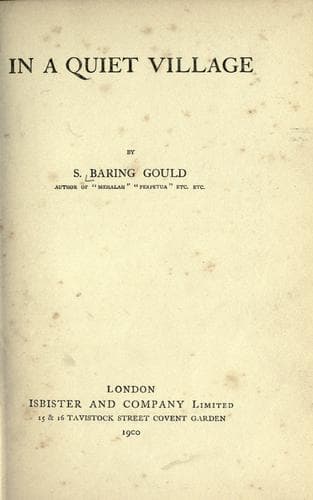
England -- Fiction; Short stories, English; Villages -- Fiction; Wales -- Fiction
“Oh! Cicely, after so many years!”—my mother’s eyes filled. She really
loved that girl, and from the depth of my heart I believe Cicely loved
her, but she was too perverse to show it.
“Now,” said Cicely to herself, “I’ll have no more nonsense.” By which she
meant that she would drive all thoughts of Will from her head. But this
is easier said and resolved on than accomplished. And you, we will say,
think that your thoughts, or fancies, are in your own power, that you can
trifle with them, and, when you like, put them aside. But when the day
comes that you _do_ wish thus to be rid of them, then you find yourself
entangled, chained in the passion, and you cannot break from it. So was
it with Cicely. She thought and worked for her old father more zealously
and lustily than she had for us, but only thought the more continuously
on, and suffered the keener for, young Will Swan.
Summer was over; autumn harvests were gathered in; Martinmas summer had
brooded over the land, enveloping all in a warm, lovely haze; and then,
suddenly came the change. Without warning an equinoctial gale burst on
the coast, the summer was over, the brightness past—winter had come with
gloom and sadness.
On the evening after it had been blowing great guns all day, the door was
thrown open, and one of the coastguard looked in.
“Jan Crowe!” called he to Cicely’s father, who had charge over the
lifeboat, “there’s the _Marianne_ wrecked.”
“The _Marianne_!”
Cicely uttered a cry. That was Will Swan’s vessel, or, rather, the vessel
in which Will Swan was. She ran down to the beach. The sea was almost
indistinguishable from the air, so lashed and shaken together was wave
with wind, so intermingled were foam and rain. The air was filled with
sound. The sands trembled with the beating of the surf on them. The whole
sky was brown and blurred with clouds sweeping along from the west,
inland, with screaming sea-birds peppered against the vapour, and salt
tears dripping out of it; now driving in rushes, then staying and drawing
up as a veil, and allowing the wind full play to riot and rend between
the clouds and the ocean.
All colour was gone out of land and sea and sky—gone as though melted
together into one medley of dull grey, never to be gathered together
into pure colour again. No outlines were clear. The bold points of land
that ran out into the sea were so be-hazed with spoondrift and rain that
they had changed their appearance, they had lost their consistency, they
seemed to waver and threaten to dissolve into the seething flood that
beat about them.
None but an experienced eye could distinguish the _Marianne_ in the haze
and tossing mass of sea.
Men and women, in fluttering garments, were on the beach, with their
hands to their eyes screening them, gazing seaward.
Public-domain text, read in full here on John Shaqi.
Reviews
Reviews
No reviews yet
Be the first to share your thoughts on this work.
Elsewhere in the archive
Join the Discussion
Join the discussion
Sign in to leave a comment or review.
Sign InorCreate an account