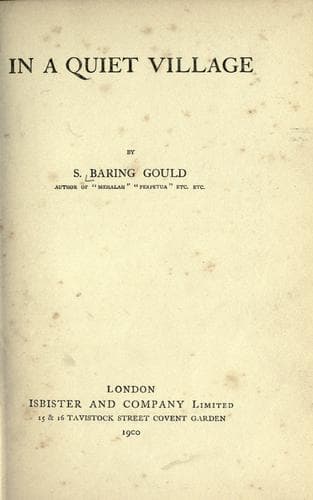
England -- Fiction; Short stories, English; Villages -- Fiction; Wales -- Fiction
Cries rose for the boat to be launched. But in such a sea it was not
possible to do anything. The _Marianne_ was a wreck. No living being
was on her. The captain of the coast-guard put his glass to his eye and
looked steadily at the tossing—now seen, now obscured—patch that was once
the _Marianne_. In the gathering darkness little could be distinguished.
“They’ve left her,” he said. “There’s none aboard but a dog. Hark! you
can hear him bark.”
Those near held their breath.
“I can’t hear nothing,” said a seaman.
“You can if you look through my glass,” said the captain, “you can then
both see and hear the little dog yapping. He wouldn’t be yapping like
that unless he’d been left behind.”
“But where be they? There was Cap’n Thomas, and Simon Feathers, and Joe
Wilcock, and Bill Swan.”
“Aye,” said another, “and there’s Tony Graves; his mother be here in a
terrible take-on. ’Tis the first time the boy has been so far to sea.”
“Where be they?” asked the captain. “I can’t see anything of a boat.
They’ve took to it, sure as I’m here, and just as certain she’s capsized.”
“Then they’ll be washed ashore, dead or alive,” said one.
“Of course they will. ’Tain’t no use trying the lifeboat when you know
they’re not in the vessel. You don’t know where to look for ’em.”
So the shore was searched, and, first one, then another was recovered;
the boy Tony first, alive and not much the worse; then Joe Wilcock dead,
or so near death that there seemed no chance of recovering him. With the
barbarous ignorance then common, he was thrown across a barrel to let the
water run out of his lungs. He struggled, gasped, and was still.
Captain Thomas, a large stout man, holding to an oar, forged his way
ashore, but he was much bruised and cut by having been beaten against
sharp slate rocks like razors. He could not speak, but his eyes were
lively, black eyes under white bushy brows. After a quarter of an hour he
gasped out, “Where’s Tony? I stood my life to his mother I’d bring him
safe home.”
“Safe he is,” said some one near.
“Then that’s right,” said the captain. “Where’s the rest?”
They could tell him only of Joe Wilcock. Feathers and Swan had not been
washed ashore.
By this time it was night. Lanterns were flashing along the beach. Then
up from the water came some one; it was Cicely, drenched to the skin, her
hair streaming, but wet as seaweed. She was dragging in her arms a dark
mass.
Some ran to her with lights. What she was heaving was Will Swan,
conscious, for he looked at her, but speechlessly. The moment others drew
nigh the girl released her load and disappeared.
The night became clearer. The wind shifted to the north, the clouds
parted. Stars appeared in the patches of dark sky. The rain ceased, but
the sea still thundered and gleamed white.
A knock at the cottage door of the old fellow who had charge of the
lifeboat. He was out still, but Cicely opened and saw Will Swan before
her with both hands extended.
Public-domain text, read in full here on John Shaqi.
Reviews
Reviews
No reviews yet
Be the first to share your thoughts on this work.
Elsewhere in the archive
Join the Discussion
Join the discussion
Sign in to leave a comment or review.
Sign InorCreate an account