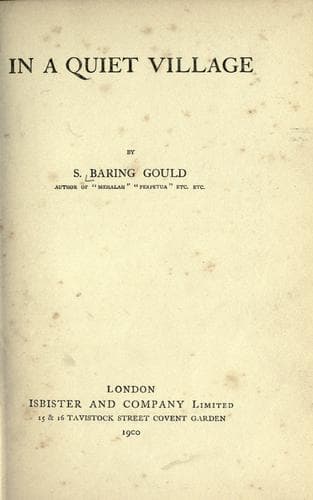
England -- Fiction; Short stories, English; Villages -- Fiction; Wales -- Fiction
“Thank you,” he said slowly. Great tears were in his eyes and rolling
down his cheeks. “I hopes the same, but I doubts it. There must be a
terrible, mirac’lous change for that to come about. But things may happen
past ’uman understanding, and even onions turn to apples, and jerseys to
pea-jackets. No offence, sir,” and he touched his forehead.
THE WEATHERCOCK
THE WEATHERCOCK
Lydia French had a shop opposite the church. The little town or
overgrown village had no market, but there were fairs held in the space
before the church on one side and Lydia French’s shop on the other
twice in the year. Both were cattle fairs, frequented by farmers. On
such occasions bullocks ran about with tails lifted, yelling men and
barking dogs behind and before them, and made either for the churchyard
wall or for Lydia French’s shop window. The Oddfellows, moreover, held
their annual feast there, and processionised behind a band, and waved
banners and wore sashes, and ate and drank heartily at the “Peal of
Bells.” On such occasions stalls were erected in the open space, where
nuts were shot for, and barley-sugar-sticks and twisted peppermint rods
and brandy-balls were sold, also ginger-pop and lemonade. On all these
occasions Lydia French’s shop was full of customers. She, moreover, had a
good _clientèle_ in the entire parish, but experienced less difficulty in
disposing of her goods than in getting her little bills paid.
But though there were defaulters, yet those who liquidated were in the
majority, or Lydia French would not have been the prosperous woman she
was. Her aspect breathed a fulness of purse and flush of comfort that
were convincing. She could afford herself, on occasion, a silk gown. She
made weekly expeditions to the bank to pay in hebdomadal profits. She had
recently repapered her little parlour, and the paper was white and gold.
She was generous. When children put down their pennies for acid drops
or almond rock, she always made the balance incline in their favour,
to their great admiration; when their mothers bought calico, she was
not particular to a quarter of a yard; and she was large-hearted—she
subscribed equally to the missionaries of Church and Chapel.
Lydia French was a widow. She had been married but for a twelvemonth to a
commercial traveller, who had in the brief year tried her forbearance and
strained her means, and she had now been a widow of three years, and was
without encumbrance.
Public-domain text, read in full here on John Shaqi.
Reviews
Reviews
No reviews yet
Be the first to share your thoughts on this work.
Elsewhere in the archive
Join the Discussion
Join the discussion
Sign in to leave a comment or review.
Sign InorCreate an account