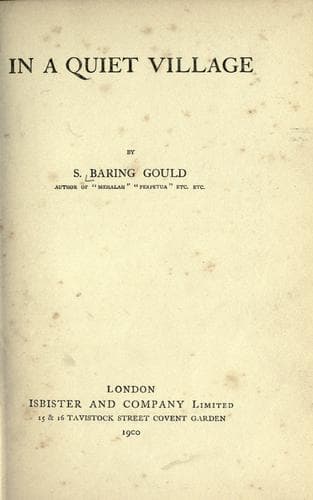
England -- Fiction; Short stories, English; Villages -- Fiction; Wales -- Fiction
Several had made advances to her, but she soon let commercial travellers
understand that none of them need apply. There was one who trafficked
in a “Life of Wellington,” with magnificent steel engravings, issued
in parts, who laid siege to her; and when he would not take a “No”
she refused to receive any more numbers of the series. Whereupon he
threatened her with legal proceedings, averring that she had bound
herself to Wellington from the cradle to the grave when she received the
first part. She paid up rather than go into court, and nursed bitterness
of heart against travellers thenceforth. The man whom she had married was
bad enough; this Wellingtonian man was “wusser,” as she expressed it. It
really was preposterous that such a woman, plump, prosperous, comely,
should not find her man.
But, indeed, there were plenty of men who wanted her, only she was hard
to please. A young farmer—she did not relish farm-work; she did not wish
to give up the shop. The blooming butcher—she had an aversion for the
trade. A handsome drover—he tippled. A Methodist class-leader—he was a
teetotaller, and she liked her drop of mild ale.
But, finally she seemed to hesitate between two—John Newbold, the mason,
and Jack Westcott—or, as the children called him, Jackie Waistcoat, the
sailor.
Both were fine men, and both had good characters; the first was somewhat
too heavy, the latter somewhat too lively. But where is perfection to be
found? In woman, perhaps—nay, certainly—not in man.
There was this advantage to whichsoever she cast the kerchief, that he
would not require her to give up the shop. To the shop she was attached.
The shop made her a power in the parish, brought her into relation with
all, gave her consequence, and drew to her a good deal of money. This,
then, was a _sine quâ non_—that she should keep the shop after marriage
as before. Besides, she did not desire to have a husband always hanging
about her, like a fly in hot weather, that will not be driven away. She
was accustomed to independence. A man on the premises all day implied
interference, and that she was determined not to tolerate.
Lydia French sat in her shop; no business was doing this day. She had
made up her account to midsummer, and the balance was good; it made
her feel good—like a bracing sermon or a melting hymn. She had taken
stock—roughly. Everything was satisfactory. The little house was in
excellent condition, she owned it; that is to say, on three lives, and
she had paid Newbold’s bill for putting it in thorough repair. The
chimney had smoked; that was cured by the new revolving cowl. The drain
from the sink had emitted smells; that was rectified—Newbold had put
down a stink-trap. Newbold was a useful man when any masoning work was
required. Could she put up with him for always—for better, for worse?
Public-domain text, read in full here on John Shaqi.
Reviews
Reviews
No reviews yet
Be the first to share your thoughts on this work.
Elsewhere in the archive
Join the Discussion
Join the discussion
Sign in to leave a comment or review.
Sign InorCreate an account