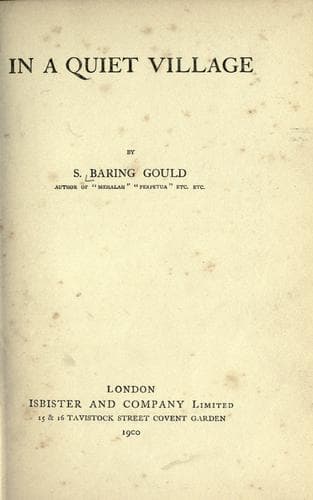
England -- Fiction; Short stories, English; Villages -- Fiction; Wales -- Fiction
She looked up, and looked out at her little window between the bottles
of pink and pallid drops, and the withered oranges that would no longer
sell, and the stay-laces, and the ginger-beer bottles, and the can of
mustard, and the tin of biscuits. And she saw that which was to her a
constant worry—the weathercock on the church spire.
In the great gale of the preceding November the cock had been blown on
one side, the spindle on which for many years it had revolved had been
bent over, so that now the poor bird lay on his back in mid-air, and
could neither right himself nor turn with the wind.
Mrs. French, neat in herself, orderly in her house, above all, in the
shop, could not endure to see what was out of place, inverted, useless.
She had liked to know from which direction the wind blew. It had provided
her with conversation with her customers. It had satisfied her sense of
the fitness of things that the spindle on the spire should be upright,
and that the vane should fulfil the object for which it was ordained.
Now more than six months had passed, and the cock was still reversed. She
had remonstrated with the parson.
“My dear Mrs. French,” he had replied, “that is the affair of the
churchwardens. I have badgered all my friends, and impoverished myself
over the restoration of the church—I can do no more.”
She complained to the churchwardens. “Lor’ bless y’,” said they, “there
be no levying o’ church-rates now, what can _we_ do?”
“It really is a scandal,” said Lydia. “And now the village feast is
coming on, and the Oddfellows will march about, and the cock will——”
“Be an odd fellow, too, turned upside down, like many of the heads after
ale and punch.”
“I don’t like it,” said Lydia. “I sees it with its blessed feet turned up
and its comb down—helpless. It is real unchristian and inhuman to let it
bide so.”
The churchwardens said, “Meddlin’ with aught on the steeple is darned
expensive. Beside, ’tain’t everywhere you can find a steeplejack.”
So Lydia fidgeted and mused and schemed: that vane became the trouble of
her life.
In at the shop door came simultaneously, from opposite directions, the
builder and the mariner.
They had a curious knack, these men, of spying on each other, and of
denying each other the opportunity of having a few words in private with
the widow.
In this, however, the sailor had the advantage over the mason, for he was
not daily engaged, as was the other. But Newbold so contrived that when
he was absent, should Westcott endeavour to steal a march on him, his
mother or his sister should invade the shop and so prevent privacy.
Which was the favoured swain neither could decide; but that was not
wonderful, for Lydia had not decided for herself.
“Good-morning, mem,” said the mason. “I’ll just trouble you for an ounce
of bird’s-eye.”
“And I’ll have same of Virginia shag,” said the sailor.
“Fine day, mem,” said Newbold.
“Which way is the wind?” asked the widow.
“East by nor’-east,” answered Westcott.
Public-domain text, read in full here on John Shaqi.
Reviews
Reviews
No reviews yet
Be the first to share your thoughts on this work.
Elsewhere in the archive
Join the Discussion
Join the discussion
Sign in to leave a comment or review.
Sign InorCreate an account