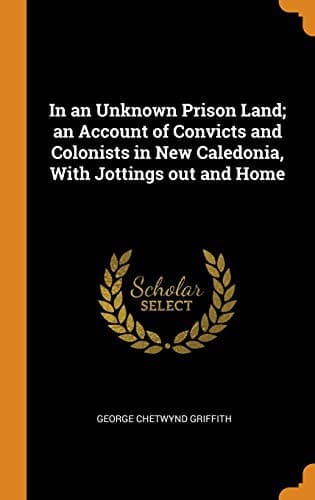
In an Unknown Prison Land: An account of convicts and colonists in New Caledonia with jottings out and homeGriffith, George Chetwynd
History
In an Unknown Prison Land: An account of convicts and colonists in New Caledonia with jottings out and home
Griffith, George Chetwynd
Crime; Criminals; New Caledonia -- Social conditions -- 19th century; Penal colonies -- New Caledonia
I could well have imagined myself driving through a thriving little
colony of freemen in some pleasant tropical island upon which the curse
of crime had never descended, and I said so to the Commandant.
“Yes,” he said, “it looks so, doesn’t it? Now, you see that house up
there to the left, with the pretty garden in front. The man who owns
that concession was a hopeless scoundrel in France. He finished up by
murdering his wife after he had lived for years on the wages of her
shame. Of course, the jury found extenuating circumstances. He was
transported for life, behaved himself excellently, and in about seven
years became a concessionnaire.
“He married a woman who had poisoned her husband. They have lived quite
happily together, and bring up their children most respectably.”
I was too busy thinking to reply, and he went on, pointing to the right:
“Then, again, up there to the right—that pretty house on the hill
surrounded by palms. The man who owns that was once a cashier at the Bank
of France. He was a ‘_faussaire de première classe_,’ and he swindled the
bank out of three millions of francs before they found him out. He was
sent here for twenty years. After eight he was given a concession and
his wife and family voluntarily came out to him. You see, nothing was
possible for the wife and children of a convict forger in Paris. Here
they live happily on their little estate. No one can throw stones at
them, and when they die the estate will belong to their children.”
“That certainly seems an improvement on our own system,” I said,
remembering the piteous stories I had heard of the wives and families of
English convicts, ruined through no fault of their own, and with nothing
to hope for save the return of a felon husband and father into a world
where it was almost impossible for him to live honestly.
“Yes,” he said; “I think so. Now, as we turn the corner you will see the
house of one of our most successful colonists. There,” he said, as the
wagonette swung round into a delightful little valley, “that house on the
hillside, with the white fence round it, and the other buildings to the
side. The owner of that place was a thief, a forger, and an assassin in
Paris. He stole some bonds, and forged the coupons. He gave some of the
money to his mistress, and found her giving it to some one else, so he
stabbed her, and was sent here for life.
“He got his concession, and married a woman who had been sent out for
infanticide, as most of them are here. If not that, it is generally
poison. Well, now he is a respectable colonist and a prosperous farmer.
He has about forty acres of ground well cultivated, as you see. He has
thirty head of cattle and a dozen horses, mares, and foals, to say
nothing of his cocks and hens and pigs. He supplies nearly the whole of
the district with milk, butter, and eggs, and makes a profit of several
thousand francs a year. I wish they were all like that!” he concluded,
with a little sigh which meant a good deal.
Public-domain text, read in full here on John Shaqi.
Reviews
Reviews
No reviews yet
Be the first to share your thoughts on this work.
Elsewhere in the archive
Join the Discussion
Join the discussion
Sign in to leave a comment or review.
Sign InorCreate an account