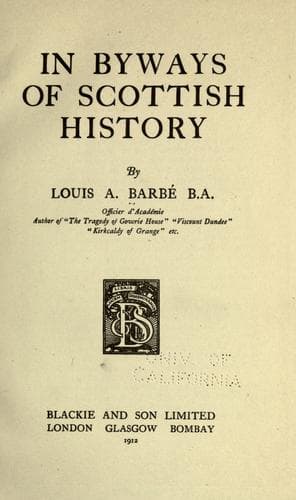
Scotland -- History -- Stuarts, to the Union, 1371-1707
But the Secretary's wife had had her own trials and her own sorrows. On
the 9th of June, 1573, her husband died at Leith, "not without suspicion
of poison", according to Killigrew. Whether he died by his own hand, or
by the act of his enemies, is a question which we are not called upon to
discuss. The evidence of contemporaries is conflicting, "some supponyng
he tak a drink and died as the auld Romans wer wont to do", as Sir James
Melville reports;[72] others, and amongst these Queen Mary herself, that
he had been foully dealt with. Writing to Elizabeth, she openly gives
expression to this belief: "the principal (of the rebel lords) were
besieged by your forces in the Castle of Edinburgh, and one of the first
among them poisoned".
Maitland was to have been tried "for art and part of the treason,
conspiracy, consultation, and treating of the King's murder". According
to the law of Scotland, a traitor's guilt was not cancelled by death.
The corpse might be arraigned and submitted to all the indignities which
the barbarous code of the age recognized as the punishment of treason.
It was intended to inflict the fullest penalty upon Maitland's corpse,
and it remained unburied "till the vermin came from his corpse, creeping
out under the door of the room in which he was lying".[73] In her
distress the widow applied to Burleigh, in a touching letter which is
still preserved. It bears the date of the 21st of June, 1573.
My very good Lord,--After my humble commendations,
it may please your Lordship that the causes of the
sorrowful widow, and orphants, by Almighty God
recommended to the superior powers, together with the
firm confidence my late husband, the Laird of
Ledington, put in your Lordship's only help is the
occasion, that I his desolat wife (though unknown to
your Lordship), takes the boldness by these few lines,
to humblie request your Lordship, that as my said
husband being alive expected no small benefit at your
hands, so now I may find such comfort, that the
Queen's Majestie, your Sovereign, may by your travell
and means be moved to write to my Lord Regent of
Scotland, that the body of my husband, which when
alive has not been spared in her hieness' service, may
now, after his death, receive no shame, or ignominy,
and that his heritage taken from him during his
lifetime, now belonging to me and his children, that
have not offended, by a disposition made a long time
ago, may be restored, which is aggreeable both to
equity and the laws of this realme; and also your
Lordship will not forget my husband's brother, the
Lord of Coldingham, ane innocent gentleman, who was
never engaged in these quarrels, but for his love to
his brother, accompanied him, and is now a prisoner
Public-domain text, read in full here on John Shaqi.
Reviews
Reviews
No reviews yet
Be the first to share your thoughts on this work.
Join the Discussion
Join the discussion
Sign in to leave a comment or review.
Sign InorCreate an account