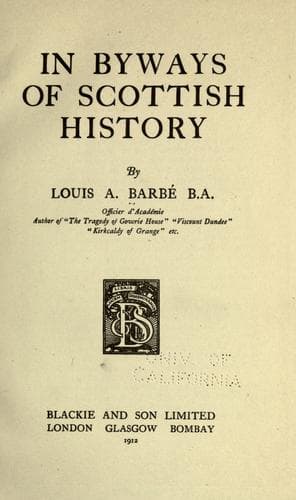
Scotland -- History -- Stuarts, to the Union, 1371-1707
N'auras-tu point le coeur touché d'affliction,
Voyant ceste belle Isle en desolation,
En proye à la discorde en guerres allumée,
Au meurtre de ses fils par ses fils animée?
Verras-tu sans douleur les soldats enragez,
Massacrer à leurs pieds les vieillards outragez,
Egorger les enfants presence de leurs peres
Les pucelles forcer au giron de leurs meres,
Et les fleuves encor regorger sur leurs bords
Par les pleurs des vivans et par le sang des morts?"[183]
Enlarging on this idea, the Councillor urges the Queen to put her
prisoner to death:--It is a pious deed to kill a murderess; it cannot be
displeasing to a just God that punishment should be inflicted on the
wicked; and, moreover, has not the impunity of vice often brought ruin
and death on kingdoms and on kings? To such arguments as these,
Elizabeth replies that kings and queens are answerable to God alone;
that Sovereigns who put their enemies to death increase instead of
diminishing their number; and that severity only engenders hatred. And
her last words contain the half-expressed resolve to try what clemency
will do to disarm her rival. This the Councillor meets with the
significant question--
"d'un ingrat obligé
Que peut-on espérer que d'en être outragé?"[184]
To close the act the Chorus then appears and sings the delights of the
golden age and the simple life, as compared with the troubles and
anxieties that embitter the existence of princes.
When the short second act opens, sentence of death has been passed on
Mary Stuart, and the Estates of England appear before their Queen to
demand that, for their safety, the sentence shall be carried out.
Elizabeth accedes so far as to promise that she will leave the matter in
their hands. But that is only a device to gain time. As soon as she is
by herself, she calls up a vivid picture of what foreign nations and
posterity will think of her if she allows the blood of a Sovereign to
stain the scaffold, and is so horrified at it that she determines to
interfere. She leaves the stage and disappears from the tragedy with the
words:
"Je rompray cependant le coup de l'entreprise".[185]
In spite of the hopes inspired by Elizabeth, the next act introduces
Davison, who has been dispatched to notify her sentence to the royal
prisoner, and who, in an effective monologue, expresses his sense of the
responsibility which he is incurring and of the odium which he will be
made to bear:
"La charge qu'on m'impose est certes bien fascheuse,
Mais je crains qu'elle soit encor plus perilleuse:
Je vay fraper un coup, mais soudain je le voy,
Je le voy, malheureux, retomber dessus moy.
* * * * *
Justement poursuivi de rancune et d'envie,
Pour m'estre à ce forfait ainsi tost resolu,
De tous également je seray mal voulu.
* * * * *
Public-domain text, read in full here on John Shaqi.
Reviews
Reviews
No reviews yet
Be the first to share your thoughts on this work.
Elsewhere in the archive
Join the Discussion
Join the discussion
Sign in to leave a comment or review.
Sign InorCreate an account