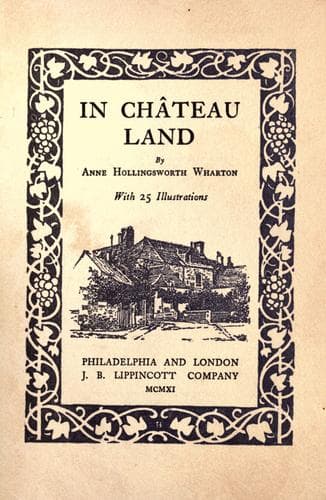
Castles -- France; Touraine (France) -- Description and travel
Despite his philosophy I truly think that the man of the party has left
his heart at Bellagio, as I heard him telling a brother angler, whom he
met at the boat landing, how fine he found the fishing there and that he
doubted the sport being as good at Stresa--at least for amateur
fishermen. The associations here are less inspiring than those of Como,
the presiding genius of Stresa being San Carlo Borromeo, whose thirst
for the blood of heretics gained for him the title of Saint. A great
bronze statue at Arona now proclaims his zeal for the Church. Miss
Cassandra, who has an optimistic faith in a spark of the divine in the
most world-hardened saint or sinner, reminds me of Carlo Borromeo's
heroic devotion to the sufferers from famine and the plague at Milan in
1570 and 1576. So, with a somewhat gentler feeling in our hearts toward
"the Saint," we turned our faces toward Isola Bella and its great
chateau, built by a later and more worldly-minded member of the
Borromean family, Count Vitaliano Borromeo. This chateau, which from the
lake side appears like a stronghold of ancient times, is fitly named the
Castello, and after admiring its substantial stone terrace and great
iron gates we were prepared for something more imposing than what we
found within. The large rooms, with their modern furniture and
paintings, some of them poor copies from the old masters, were strangely
out of harmony with the ancient exterior of the Castello; but they were
shown to us with great pride by the custodian, who must have found us
singularly unappreciative and lacking in enthusiasm, even when he
displayed a room in which the great Napoleon had once slept. When
Napoleon was here, and why, and whether he was here at all, does not
concern any of us especially, except Lydia, who having a turn for
history is always determined to find out how, why, when, and where. I am
glad that she does care, as her example is edifying to us all,
especially so to Christine and Lisa, who follow her about and ask
questions to their hearts' content, which she is never tired of
answering. The garden, we revelled in, and found it hard to believe that
the terrace, which rises to a height of one hundred feet, was once a
barren rock until Count Borromeo covered it with a luxuriant growth of
orange, olive, and lemon trees, cedars, oleanders, roses, camellias, and
every tree and plant that you can think of. It is really a bewilderingly
lovely garden, and we wandered through its paths joyously until we came
suddenly upon some artificial grottos at one end overlooking the lake.
These remarkable creations are so utterly tasteless, with masses of
bristling shellwork and crude, ungainly statues, that we wondered how
anything so inartistic could find a home upon Italian soil. The
children, however, found delight in the hideous grottos, were sure that
they had been robbers' dens, and fancied they heard the groans of
prisoners issuing from their cavernous openings. They were so
Public-domain text, read in full here on John Shaqi.
Reviews
Reviews
No reviews yet
Be the first to share your thoughts on this work.
Join the Discussion
Join the discussion
Sign in to leave a comment or review.
Sign InorCreate an account